
How to write high-quality SEO articles? A complete method from topic selection and keywords to AI search optimization.
High-quality SEO articles are not simply about keyword stuffing; rather, they revolve around real user needs and involve systematic optimization through topic research, keyword systems, search intent analysis, information increments, EEAT (External Evidence, Access, and Automotive Attraction), content structure, internal linking, and technical SEO. This article, combined with AI search trends, provides a complete explanation of how to create high-quality content suitable for both Google SEO and GEO.
existSearch Engine Optimization (SEO)In this context, content has always been one of the most important foundations for acquiring organic traffic.
Even if a website has an excellent technical architecture, fast loading speed, standardized sitemap, complete schema, and good server configuration, it will still be difficult to continuously obtain stable organic search traffic if it lacks truly valuable content in the long term.
The reason is simple:
Ultimately, search engines need to solve the user's problems.
Content is the main vehicle through which a website expresses to search engines and users "who we are, what we know, and what problems we can solve".
However, many companies still have a misconception about SEO content:
SEO writing is about finding keywords and then repeatedly using those keywords in your articles.
This method is unlikely to produce long-term effects today.
Truly high-quality SEO content is not "articles written for the algorithm," but rather content that revolves around real user needs, combining search intent, professional experience, company data, case studies, and credible evidence to create content that is easily understood by search engines and can genuinely help users solve problems.
This article will systematically explain the complete process of creating high-quality SEO articles from the following aspects:
- How to choose a worthwhile topic to write about
- How to build a keyword system
- How to determine search intent
- How to design content structure
- How to create information increment
- How to establish EEAT
- How to perform page SEO optimization
- How to structure internal links
- How to create content in the AI era
- How to make content suitable for both SEO and AI search
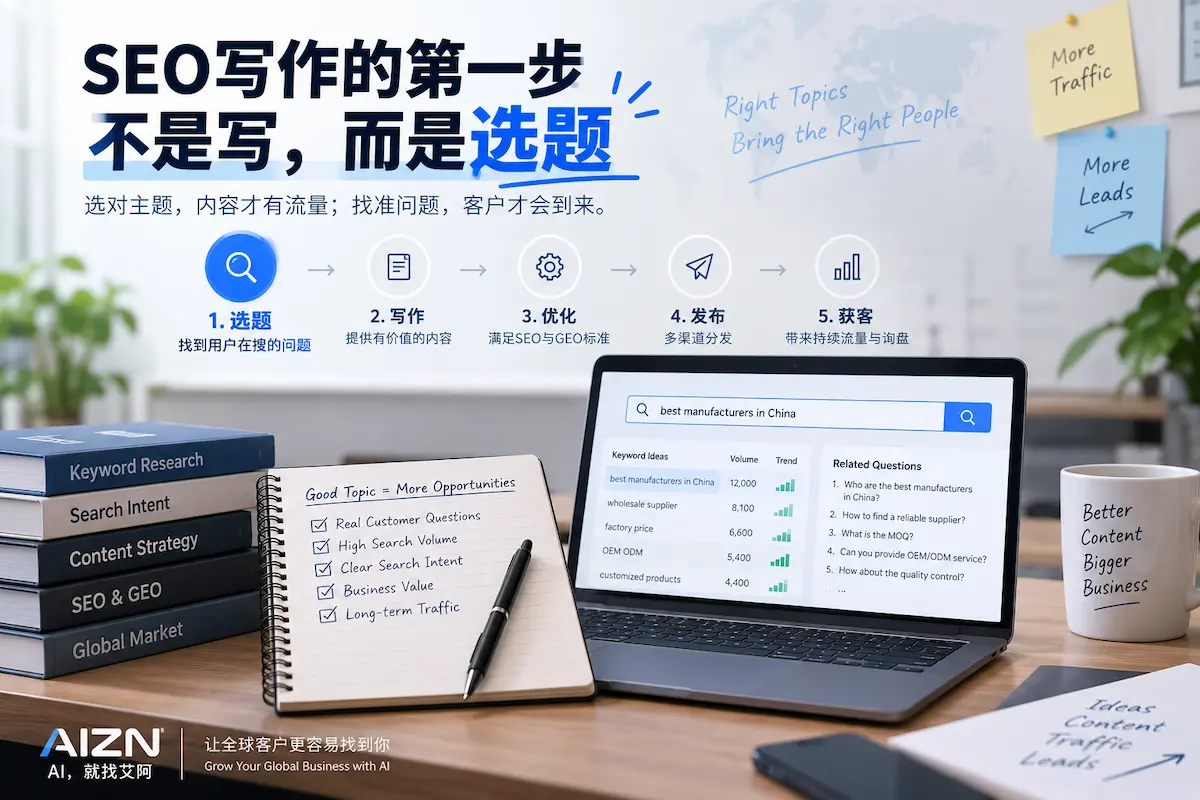
First, the first step in SEO writing is not writing, but choosing a topic.
Many SEO content articles don't get traffic, not because they're poorly written, but because the topic was chosen incorrectly from the start.
A topic without real search demand may remain unsearched even if a lot of time is spent on it.
Therefore, before formally writing, the first thing to do should be to confirm:
Would the target customers actually search for this question?
A worthwhile SEO topic to invest in long-term typically needs to meet several conditions simultaneously:
- There is genuine search demand;
- Related to the company's products or services;
- It can cover the problems encountered by target customers in the procurement process;
- There is an opportunity to build professionalism through content;
- Ultimately, it can lead to a relationship with inquiries, consultations, or orders.
Common sources of SEO topics
Companies can find topics from the following channels.
1. Google search results
Directly search for core product keywords and observe:
- Google AutoSuggest
- People also asked
- Related Searches
- Top 10 pages
- Videos, pictures, forums, and shopping results
This information can help determine what users truly care about.
For example, a company that manufactures industrial valves should not simply write:
Industrial valves
We can further expand on this topic by focusing on the procurement scenario:
- How to choose industrial valves?
- Ball valves and gate valves
- Best valve materials for corrosive fluids
- How to select the valve pressure rating?
- Chinese industrial valve manufacturers
- What certifications are required for industrial valves?
These questions are easier to match with procurement needs than simply writing an article around a big term.
2. Google Search Console
If the website already has some exposure, you can...Google Search Console Check:
- Which keywords are already displayed?
- Which keywords rank between 10 and 50?
- Which pages have low click-through rates?
- Which keywords have exposure but no dedicated pages?
This data is often very valuable.Content and Keyword Opportunities。
3. SEO tools such as Ahrefs and Semrush
You can focus on the following:
- Search volume
- Keyword Difficulty
- Transportation potential
- Related keywords
- question
- Competitor keywords
But you can't just look at search volume.
referenceSEO tool dataFor B2B companies, high-purchasing-intent keywords with only a few dozen searches per month may have a much higher actual commercial value than general industry terms with tens of thousands of searches per month.
4. Real problems encountered by the sales team and customers
This is a type of content source that many companies tend to overlook.
Sales staff receive customer questions daily, such as:
- What is the MOQ?
- How long is the delivery time?
- Does it support OEM?
- Which material is more suitable?
- How to choose a model?
- Can it be customized?
- Does it comply with CE / UL / FDA / RoHS?
- How to resolve a product malfunction?
These questions themselves are excellent SEO topics.
Because they come from real customers, not just from keyword tools.
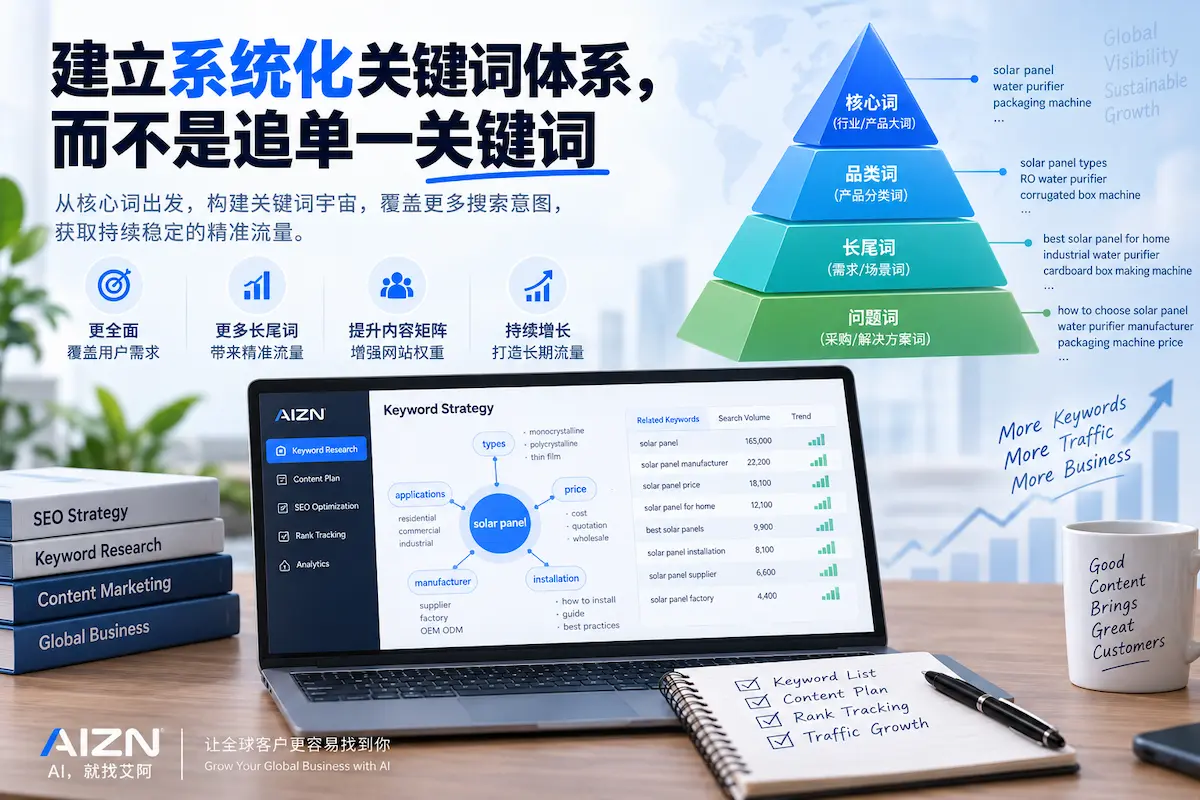
Second, establish a systematic keyword system, rather than pursuing a single keyword.
A mature SEO content strategy rarely involves writing articles repeatedly around a single keyword.
A more effective approach is to establish a complete Keyword: Universe and Topic Cluster。
A topic can usually be divided into three levels.
1. Core Keywords
The core keywords represent the entire product or industry.
For example:
- Industrial valves
- LED lighting
- Brake fluid
- Customized packaging
- Safety shoes
These types of keywords usually have high search volume, but the competition is also quite fierce.
2. Long-tail keywords
Long-tail keywords are more specific and often closer to real needs.
For example:
- Chinese industrial valve manufacturers
- Custom LED light manufacturer
- DOT 4 Brake Fluid Supplier
- Low minimum order quantity custom packaging supplier
- Safety shoes with composite material toe caps
For foreign trade B2B companies, long-tail keywords are often a better priority to focus on.
The reason is that user needs are more clearly defined.
3. Semantically related keywords
Google now understands that content is not just about how many times a particular keyword appears.
It also determines whether the entire content fully covers the relevant entities and topics.
For example, an article about industrial valves might naturally involve:
- Pressure level
- temperature
- medium
- seal
- Stainless steel
- carbon steel
- API
- American National Standards Institute
- from
- Actuator
- maintain
These words don't necessarily need to be mechanically repeated, but they can help search engines understand the topic of an article more accurately.
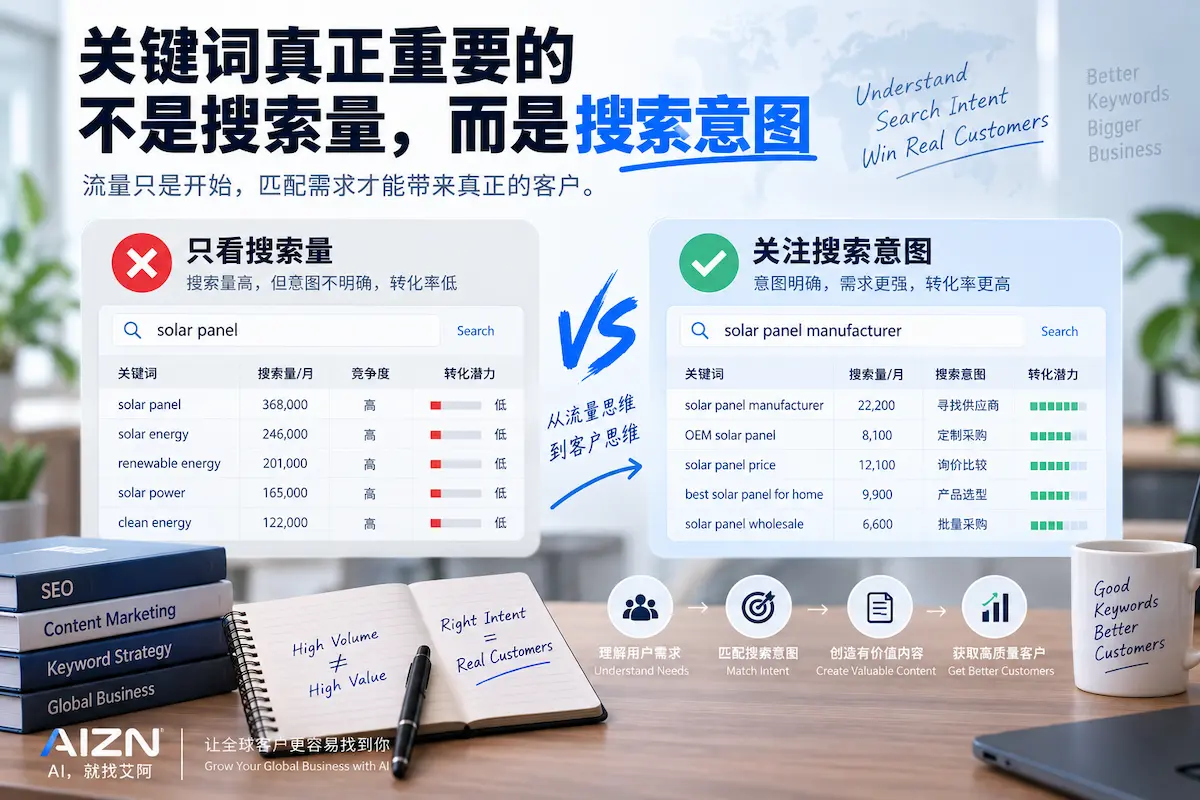
Third, what truly matters about keywords is not search volume, but search intent.
The essence of SEO ranking is not just keyword matching, but:
Matching page content with user search intent.
The same product may represent completely different needs depending on the search terms used.
Search intent can generally be divided into four types.
1. Information-based
Users are learning about knowledge.
For example:
What is a ball valve?
This type of content is suitable for knowledge articles, guides, and tutorials.
2. Business Survey Type
The user has already generated a purchasing need and is comparing different options.
For example:
Ball valves and gate valves
or:
China's Best Industrial Valve Manufacturer
This type of search intent usually has high commercial value.
3. Product Comparison
Users have entered the selection phase.
For example:
Stainless steel valves and brass valves
This type of content is very suitable for B2B companies to create technical content.
4. Transactional
The user is close to making a purchase.
For example:
Chinese industrial valve suppliers
OEM valve manufacturer
Wholesale safety shoe supplier
forForeign Trade Independent WebsiteIn general, these types of keywords should be prioritized for development:
- Product Page
- Category Page
- Solution Page
- Supplier Page
- RFQ page
Instead of writing everything as blog posts.
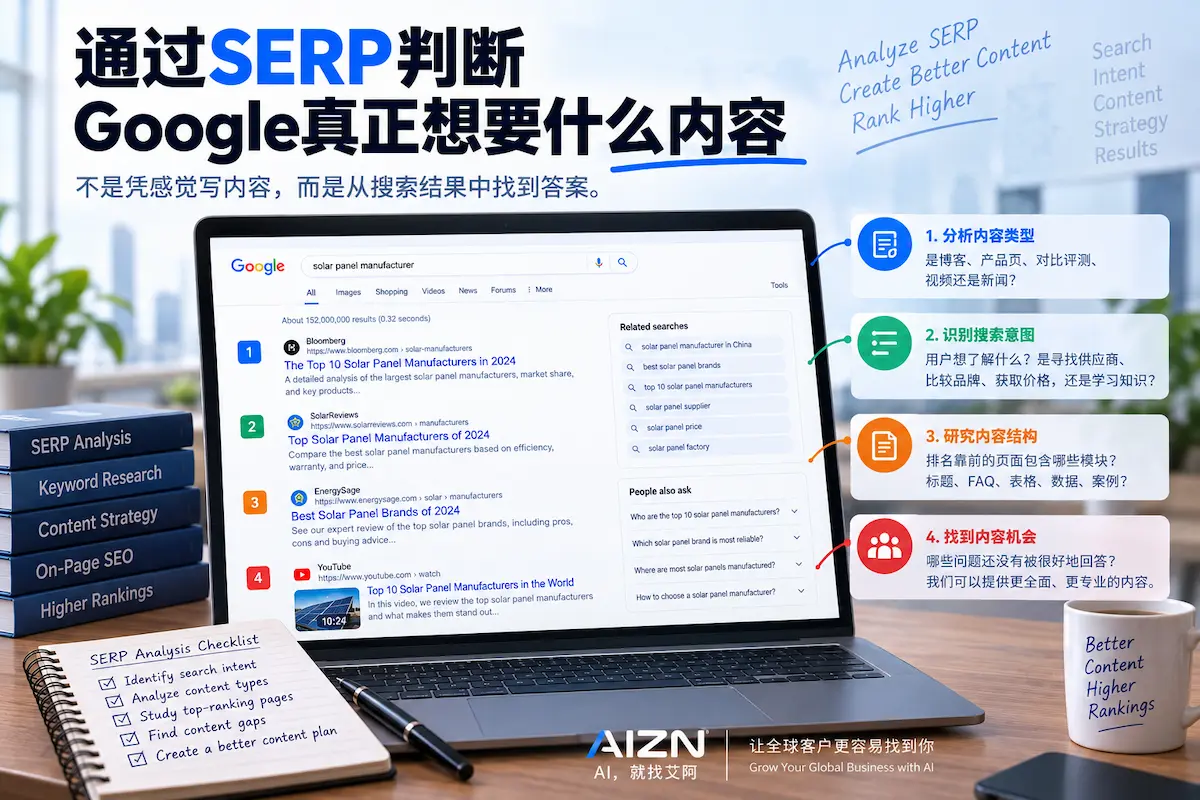
IV. Determining what content Google truly wants through SERPs
Keyword tools can only tell you "someone searched for it".
But it can't tell you everything:
What type of pages does Google want to show users?
Therefore, before writing an article, it is necessary to...Analyze SERPs and follow Google Search Basics。
We recommend checking the top 10 results:
- Is it a blog post or a product page?
- Is it a guide or a ranking list?
- What is the approximate length of the content?
- Does it include a table?
- Is there an FAQ?
- Do you have any pictures or videos?
- Is price emphasized?
- Should parameters be emphasized?
- Should we show some case studies?
For example:
If the top 10 search results are almost all:
Top 10 manufacturers
Therefore, the user is most likely comparing suppliers.
If the top 10 are mainly:
What is...?
Users are primarily in the knowledge acquisition stage.
The first step to excellent SEO content is understanding:
What do users really want to see?
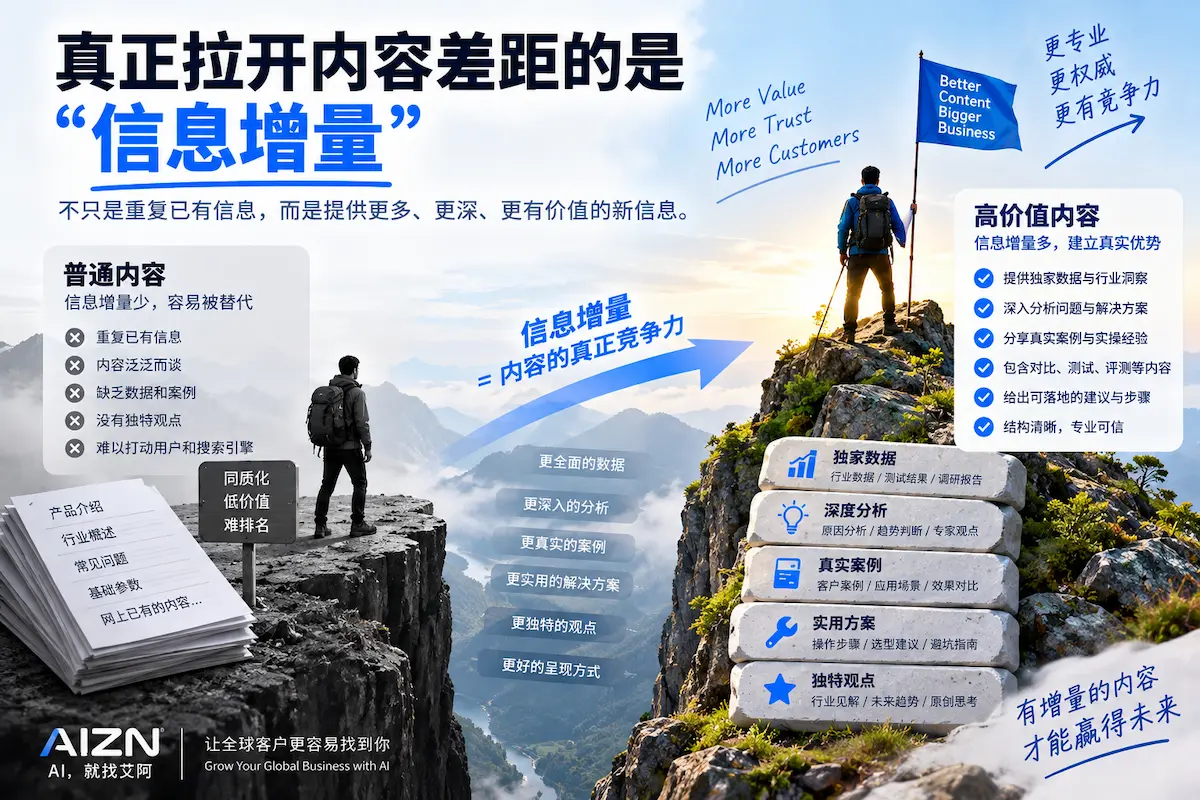
Fifth, what truly differentiates content is the "information increment."
With the popularization of AI, the biggest change on the internet is not that there is less and less content, but that there is more and more content.
A large number of articles can be generated quickly:
- Product Introduction
- Basic Definition
- Advantages and disadvantages
- Frequently Asked Questions
- Industry Overview
Therefore, truly competitive content must answer one question:
What information does your article provide that others don't?
This is information increment.
Information increments can come from the following aspects
1. Original data
For example:
- Actual test data
- Product Performance Comparison
- Production data
- Customer feedback
- Delivery cycle
- Cost changes
2. Real-world business experience
For example:
We have provided this type of product to 230 overseas clients over the past 5 years.
This kind of firsthand experience is far more valuable than general introductions.
3. Product Testing
For example:
- Waterproof test
- Life test
- Temperature test
- Corrosion resistance test
- Load testing
- Material comparison
4. Client Cases
Case studies should not only include:
The customer was very satisfied.
What's even more valuable is the complete process:
Customer issue → Original solution → Technical adjustments → Testing process → Final result.
5. Engineering experience
For example:
If the operating temperature exceeds 200°C, we generally do not recommend using certain sealing materials.
This type of content is very easy to differentiate professionally.
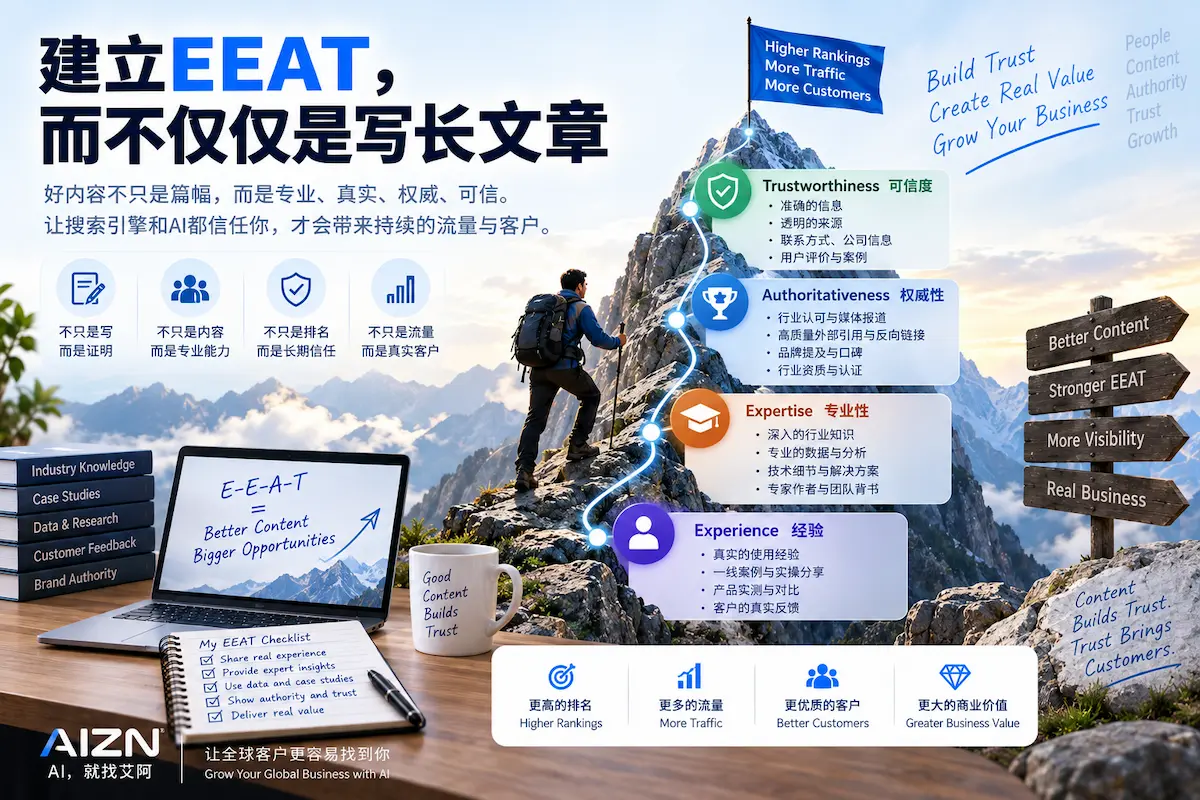
VI. Build EEAT, not just write long articles.
Google's judgment of high-quality content goes beyond just its length.
More importantly:
Experience, expertise, authority, credibility
That is to say:
- experience
- professionalism
- authoritative
- Credibility
For corporate websites, the following aspects can be considered:Enhancing EEAT and Brand Trust。
Showcase the real authors
The article can display:
- Author's Name
- Position
- Professional background
- Work experience
Showcase real enterprise capabilities
include:
- Factory photos
- Production equipment
- laboratory
- Certification
- Test report
- Client Cases
Provide data source
If an article cites statistics, the source should be cited.
Display update time
For content related to technology, regulations, and product trends, the following can be displayed:
Updated in September 2026
It makes it easier for users and search engines to determine whether information is still valid.
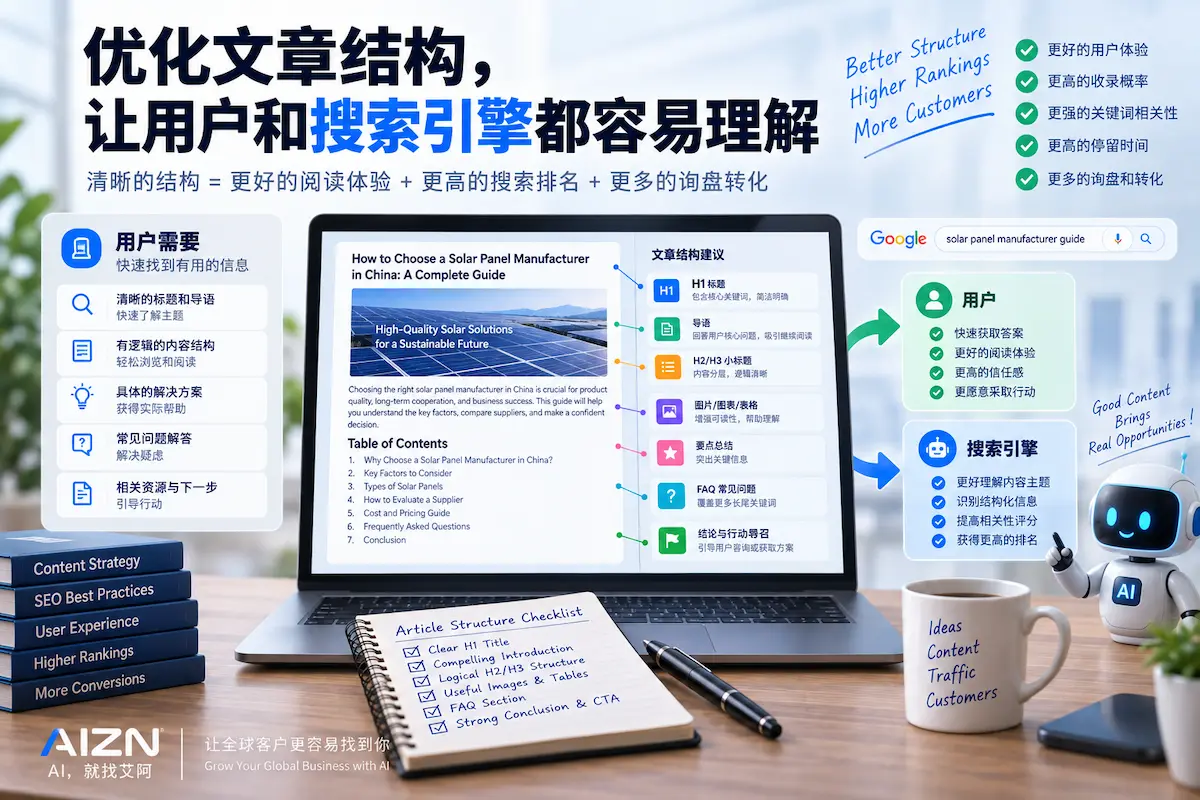
7. Optimize the article structure to make it easy for both users and search engines to understand.
SEO content cannot simply be a lot of information.
It must also be easy to read.
After entering an article, users typically don't read from the first sentence to the last, but rather scan quickly:
- title
- Subheading
- sheet
- picture
- data
- Frequently Asked Questions
Therefore, the content structure is very important.
Recommended use:
H1
The entire article has only one core theme.
H2
Corresponding to the core chapters.
H3
Responsible for explaining the details.
It is also recommended that:
- Each segment should not be too long;
- Use bullet points more often;
- Use tables for parameters whenever possible;
- Explain complex concepts with pictures;
- The article begins by directly answering the question.

8. Answer the user's question directly in the first 100 words.
This is the part that many SEO content creators most easily overlook.
Many articles begin with:
With economic development...
With the continuous advancement of the internet...
Users often still don't know the answer even after reading several sentences.
A better approach is to answer directly.
For example:
User Search
What is GEO?
You can answer directly at the beginning of the page:
GEO (Generative Engine Optimization)It is a method to improve a brand's chances of being understood, cited, and recommended in AI search results such as ChatGPT, Google AI Overview, and Perplexity by optimizing website content, entity information, and structured data.
Users can get the answer immediately.
This content structure is also more suitable for search engines and AI crawling.
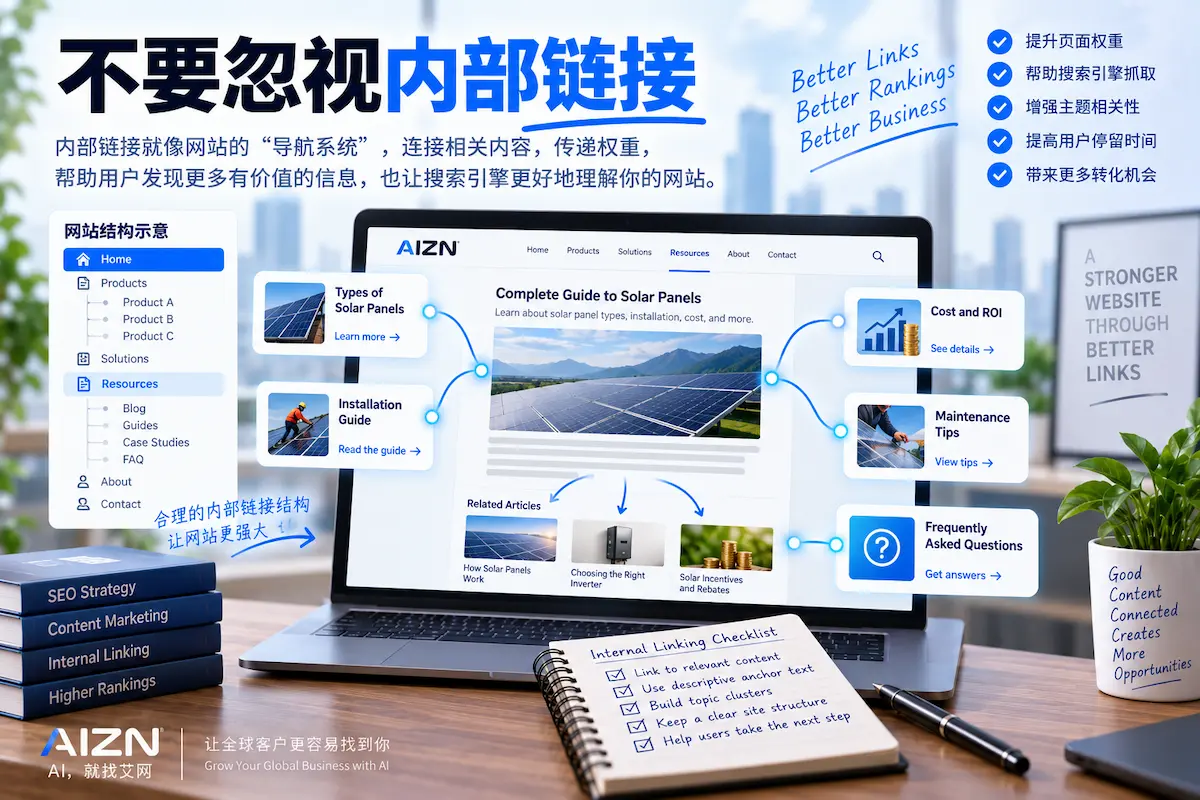
9. Don't overlook internal links.
SEO Content and Technology FundamentalsNone of them exist in isolation.
A truly mature website should form a content network.
For example:
Industrial Valve
│
├── Ball Valve
│   ├── Ball Valve Types
│   ├── Ball Valve Materials
│   └── Ball Valve Applications
│
├── Gate Valve
│
├── Valve Selection Guide
│
└── Industrial Valve Manufacturer
Different pages are interconnected via Internal Links.
Internal links can help:
- The user continues browsing;
- Google discovered a new page;
- Establish page theme relationships;
- Assign page weight;
- Build Topic Authority.
Therefore, when publishing each article, one should consider:
Which product pages should it link to?
as well as:
Which articles should link to it?
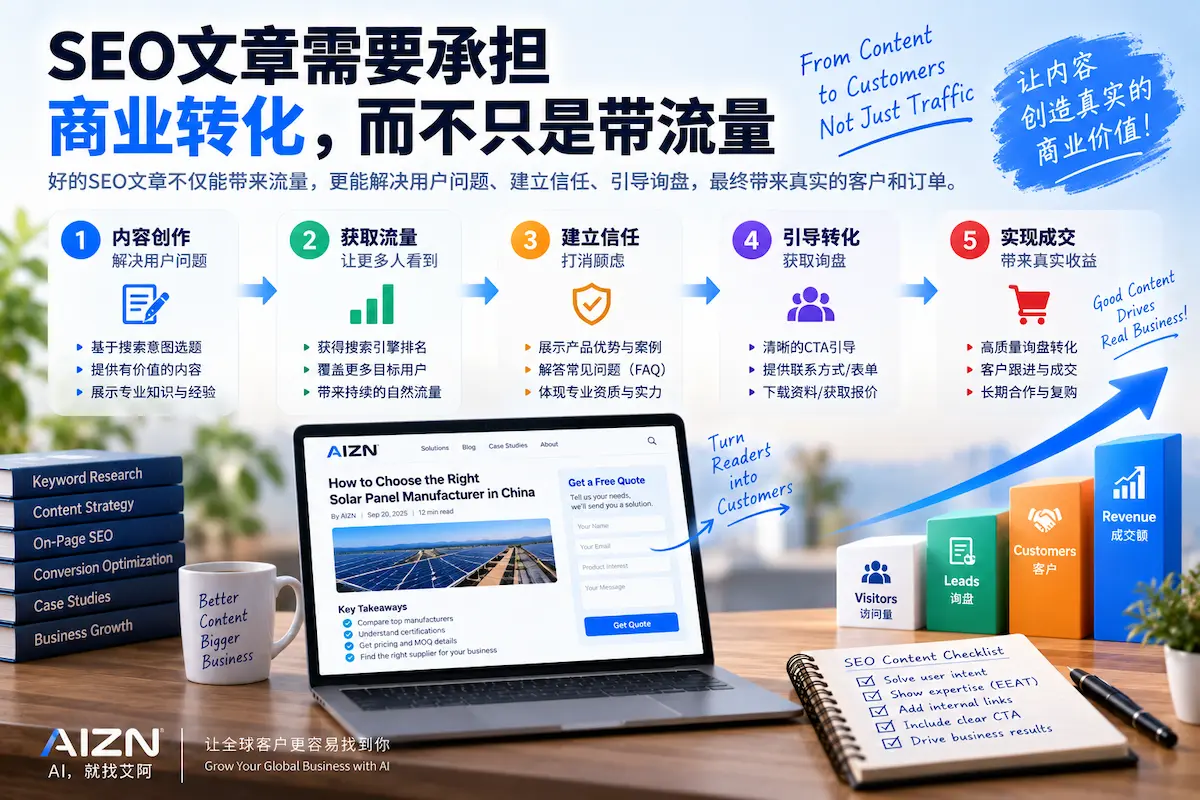
10. SEO articles need to be commercially viable, not just drive traffic.
The ultimate goal of SEO for businesses is not to increase website traffic.
Instead:
Inquiries, customers, and orders.
Therefore, content pages should be designed with reasonable conversion entry points.
For example:
- Request a quote
- Contact engineer
- Download Directory
- Obtaining samples
- Contact our team
- Download technical data sheets
The CTA should also be different at different stages of the search.
For example:
Knowledge-based articles:
Download Material Selection Guide
Business-related articles:
Request a quote
Product comparison article:
Talk to the engineer
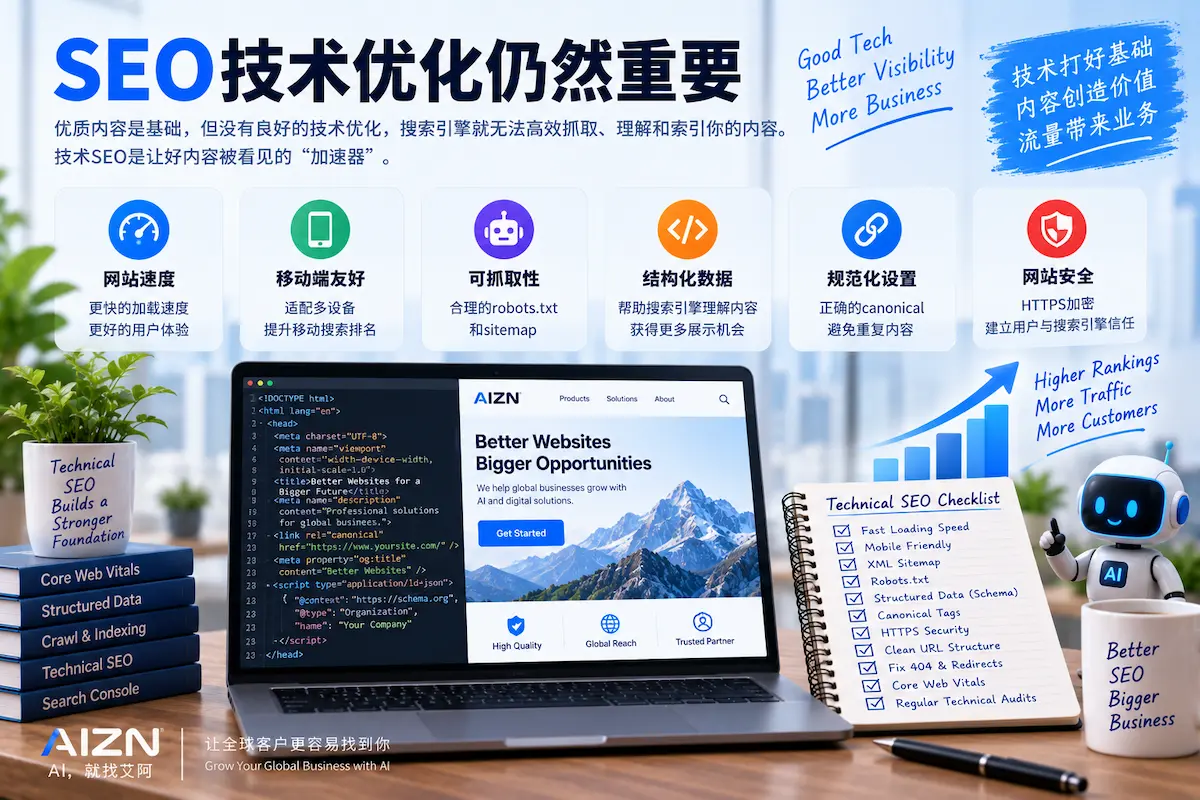
11. SEO technical optimization remains important
Content quality is key, but basic page SEO still needs to be done well.
Each article should be checked at least once:
title
It is recommended to include the core theme.
Meta description
Clearly explain what problem the page solves.
H1
One main H1 for each page.
URL
Keep it short and clear, for example:
/industrial-valve-selection-guide/Do not use:
/article?id=57381Alternate text
Provide accurate descriptions for the images.
For example:
stainless steel ball valve pressure testmodel
Avoid duplicate pages that could confuse search engine rankings.
Site Map
Make sure important articles are added to the Sitemap.
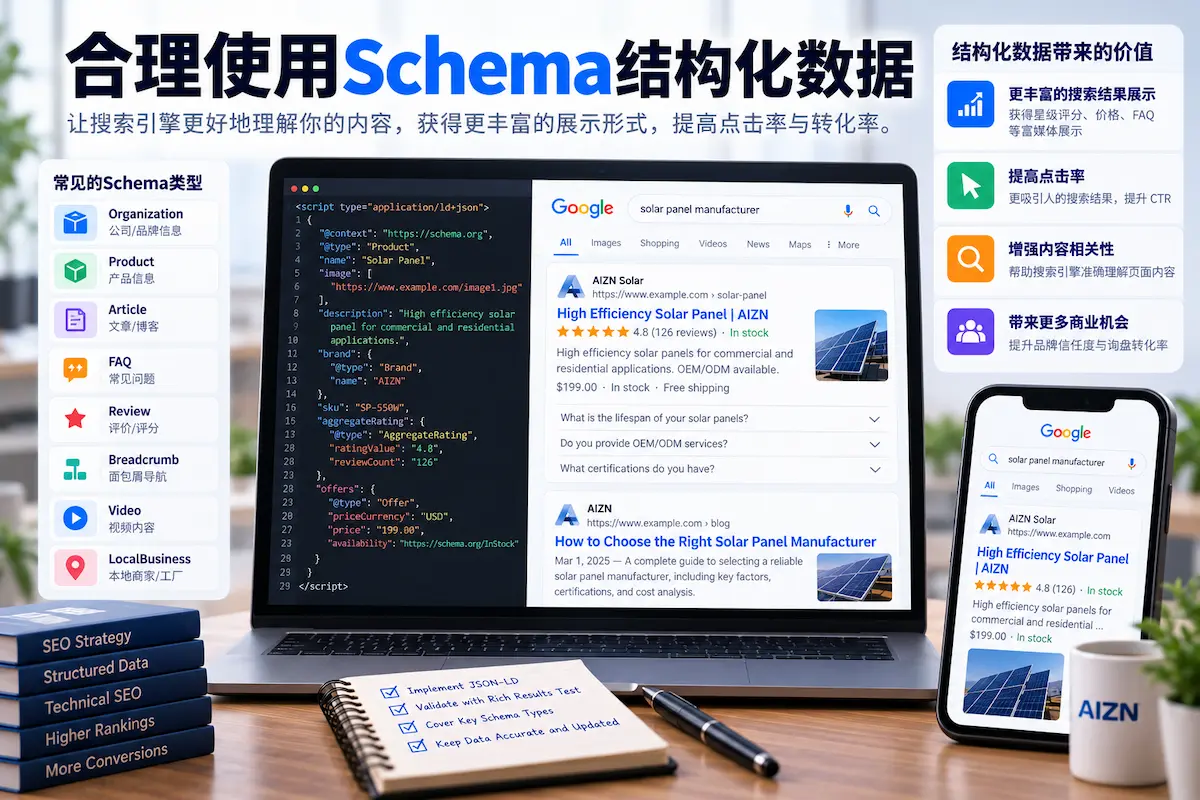
12. Make reasonable use of schema-structured data
Schema-based structured dataIt can help search engines understand page content more clearly.
Article pages could consider:
- article
- Breadcrumb navigation list
- organize
- people
- product
- Frequently Asked Questions Page
The specific type to use should be determined based on the actual content of the page.
The purpose of schema is not to directly "guarantee ranking", but to make it clearer to search engines:
- What page is this?
- Who posted it?
- What is the product?
- Who is the author?
- What is the relationship between the pages?
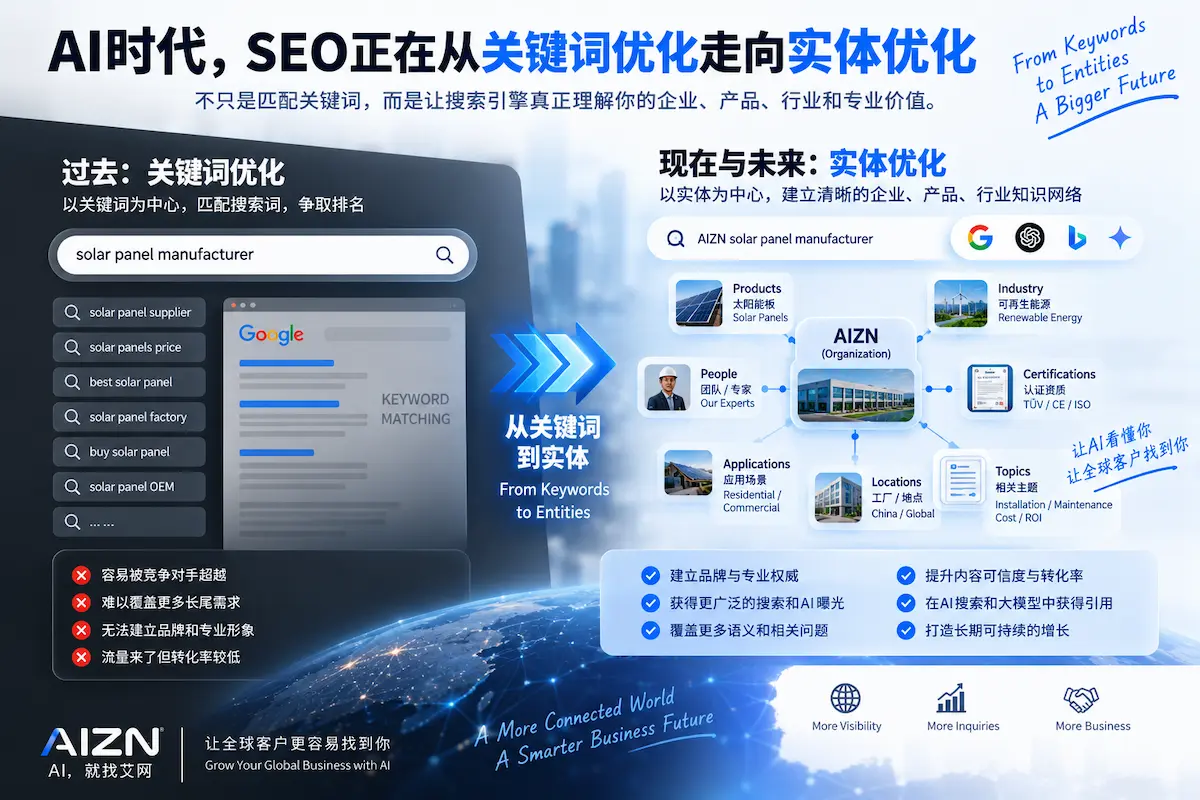
Thirteen, in the AI era, SEO is shifting from keyword optimization to entity optimization.
AI search tools such as ChatGPT, Google AI Overview, Perplexity, and Claude.It is changing the way users access information.
Users may have previously searched for:
best safety shoes manufacturers ChinaNow you might ask directly:
Which Chinese safety shoe manufacturers support OEM production and CE certification?
This means that the content needs further clarification:
- Who are you?
- What do you produce?
- Which countries do we serve?
- What abilities do they have?
- What evidence is there?
- Why is it trustworthy?
This is no longer just about keyword optimization.
Instead:
Entity + Evidence + Content + Structure
In other words, entity representation, credible evidence, content quality, and structured information.
14. Make SEO content more easily cited by AI
In the future, SEO content will also need to consider a new metric:
Citability – Citability.
That is to say:
Can AI quickly extract an accurate answer from your page?
Content citationability can be improved in the following ways.
1. Answer the question directly at the beginning.
2. Each H2 solves only one problem.
3. Key data should be presented in separate sentences.
For example:
Our standard minimum order quantity is 500 pieces.
Don't hide key conclusions in long paragraphs of 500 words.
4. Use tables more often.
For example:
| Material | temperature | Corrosion resistance |
|---|---|---|
| brass | medium | medium |
| SS304 | High | High |
| SS316 | High | Very high |
This structure is very easy for search engines and AI to understand.
15. AI can improve efficiency, but it cannot replace business experience.
AI is very suitable for:
- Keyword organization
- Topic Clustering
- SERP Information Organization
- Content Framework
- First draft
- translate
- Syntax modification
- Content Update
However, businesses should not allow AI to completely replace them:
- Technical experience
- Product Knowledge
- Client Cases
- Actual data
- Industry perspectives
- Engineering Judgment
A more reasonable process is:
关键词研究
↓
搜索意图
↓
AI生成框架
↓
AI辅助初稿
↓
工程师补充技术
↓
销售补充客户问题
↓
企业补充案例/数据
↓
SEO优化
↓
发布
Only in this way can AI truly become an efficiency tool.
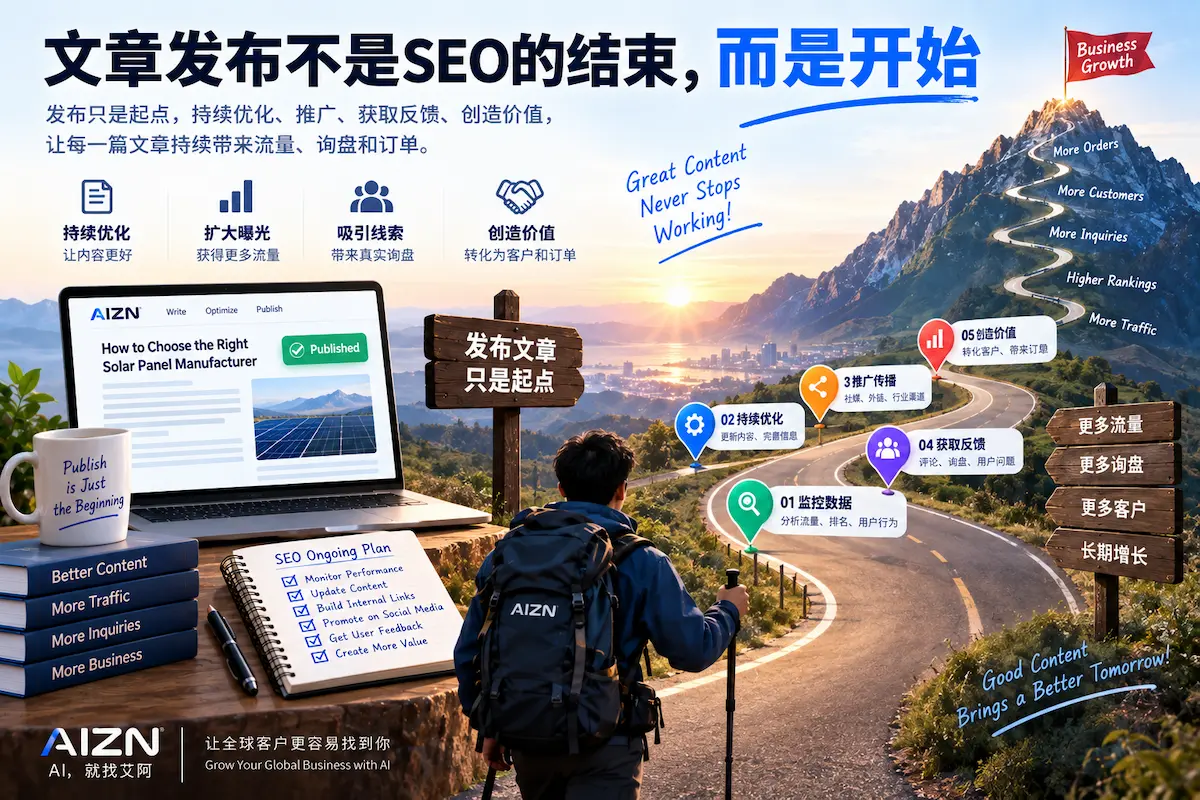
16. Article publishing is not the end of SEO, but the beginning.
Many companies stop updating their articles after they are published.
However, content that can truly maintain a long-term ranking usually requires continuous maintenance.
It is recommended to check regularly:
Google Search Console
Key observations:
- impression
- Click
- Central rate
- Average position
If the page is already ranked 11-30:
This means that Google has approved this page.
At this point, further optimization is usually worthwhile.
- Supplementary content
- Add cases
- Add internal links
- Optimize title
- Add FAQ
- Update data
17. Standard Process for High-Quality SEO Articles
An article that can truly compete for long-term rankings can be produced by following this process:
Step 1
Confirm the user's issue.
Step 2
Validate the search requirements.
Step 3
Identify the core keywords.
Step 4
Organize long-tail keywords and semantic terms.
Step 5
Analyze SERPs.
Step 6
Determine the search intent.
Step 7
Design H1 / H2 / H3.
Step 8
Include original data, case studies, and experience.
Step 9
Complete the page SEO.
Step 10
Establish internal links.
Step 11
Add a schema.
Step 12
Publish and enter GSC monitoring.
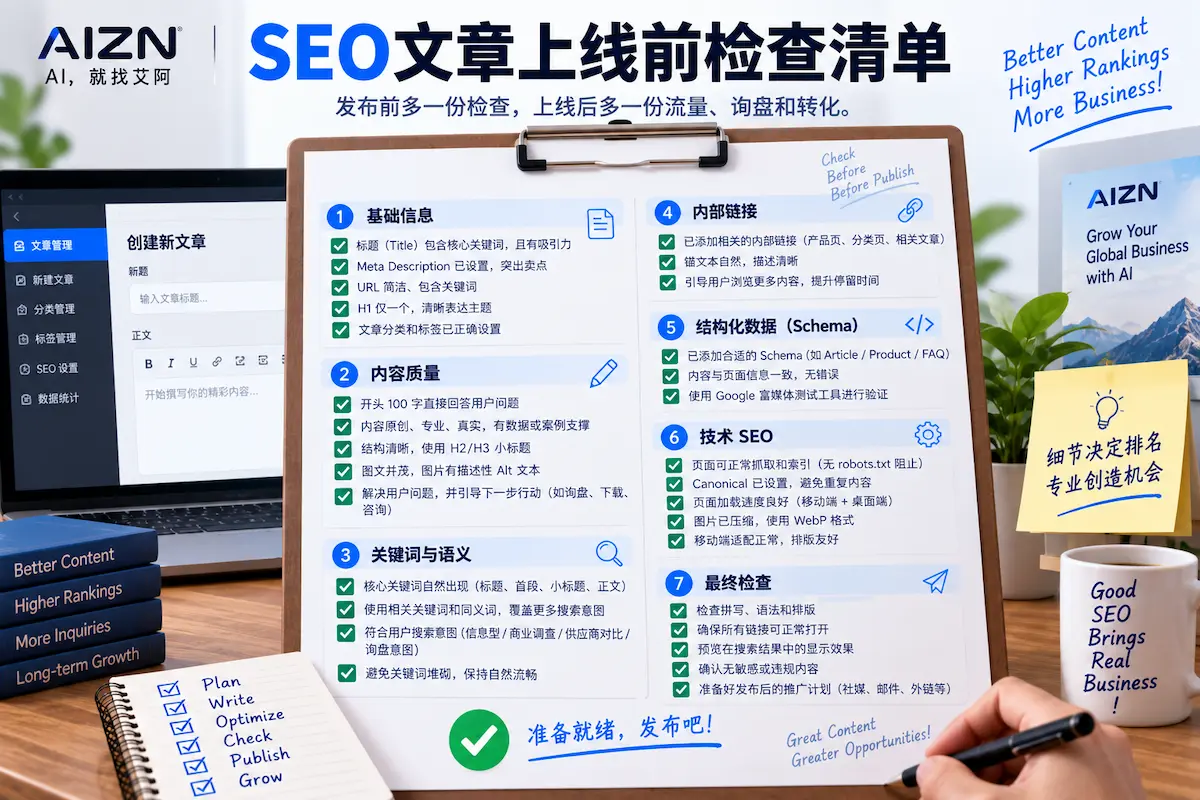
18. SEO Article Pre-launch Checklist
Before publishing each article, you can check at least the following items:
Search intent
Does the article truly solve the user's search problem?
Original information
Does it include the company's own data, experience, case studies, or perspectives?
Content completeness
Does it cover the issues that users care about most?
eat
Can it be proven that the author and company possess professional competence?
structure
Are H1, H2, and H3 clear?
this
Are the title, description, URL, and Alt text formatted correctly?
Internal links
Do you want to link to related products and articles?
model
Should we use structured data appropriate for the page type?
Call to Action
Do you provide a further conversion entry point?
Update mechanism
Can GSC be used for further optimization?
Summarize
Truly excellent SEO content is never simply "writing an article around keywords".
The complete logic should be:
User needs → Search intent → Keyword system → Content structure → Professional evidence → Page optimization → Internal links → Data feedback → Continuous updates
The core of SEO is gradually evolving from simply ranking keywords to:
Who can consistently provide more authentic, professional, complete, and easily understood and cited information?
For independent corporate websites, the true value of SEO content goes beyond simply generating traffic.
It can also help businesses:
- Establish industry expertise;
- Get organic traffic from Google;
- Covering more procurement issues;
- Enhance brand trust;
- Increase AI search exposure;
- Receive long-term inquiries;
- Build digital assets that can be continuously accumulated.
Therefore, the ultimate goal of high-quality SEO content can be summarized in one sentence:
Let customers find you, let customers understand you, let customers trust you, and ultimately be willing to establish business relationships with you.
If you are planning an independent website for foreign tradeSEO, GEO, and long-term content growthI'm unsure whether to start with keywords, content structure, or website technology.Looking for clues We can help you develop a clearer growth path by considering your industry, product, and target market. Welcome!Contact UsGet the independent website and overseas customer acquisition solutions that are suitable for your current stage.