
How to create an independent website in small languages? From multilingual websites to Google SEO and GEO to acquire customers
Small-language independent websites not only translate English websites into other languages, but more importantly, enter the search environment of local users. This article systematically introduces how foreign trade companies can expand overseas markets through multilingual websites from aspects such as language selection, keyword research, URL structure, hreflang, SEO, GEO and inquiry conversion.
Many foreign trade companies build independent websites, and their first reaction is to build an English website first.
There is nothing wrong with this idea.
English is indeed a very important communication language in the global foreign trade market. Many buyers also use English to search for suppliers, products and solutions. But if a company only builds English websites for a long time, it is easy to overlook one issue:
Just because your customers know English, it doesn’t mean they must use English when searching.
Especially in markets such as Germany, France, Spain, Italy, and Japan, when buyers search for products, suppliers, and solutions in their native languages, if your independent site only has English pages, you may not actually have entered this part of the search demand at all.
This is why more and more foreign trade companies are beginning to pay attention to multi-language independent websites.
The real value of small languages is not to simply translate English websites into German, Spanish, French or Japanese, but to allow the company's products, content, brand and professional capabilities to truly enter the search environment of local users.
For businesses doing Google SEO, this means more keywords, more search entries, and more potential customer touchpoints.
For businesses that are paying attention to GEO, multilingual content also means that your brand can be understood, cited and recommended by search engines and AI systems in more languages.
Therefore, what deserves attention for small language independent stations is not just "one more language version", but:
Let enterprises gradually move from an English market to multiple localized markets.
Why does an English website not equal the global market?
Many foreign trade bosses will have a very intuitive judgment:
"Nowadays, most foreign customers can speak English, so I can just make an English website."
This idea can indeed be established in many industries, but it cannot cover all situations.
A German buyer may be able to read English product information, but when he searches for a product, he may use German keywords directly.
For example, a Chinese industrial products company produces industrial filtration equipment.
English keywords may be:
industrial filter manufacturer
But when German buyers search, they may use local German product names, industry terms and procurement expressions.
At this time, even if your English page has very professional content, it may not be able to cover these German search needs.
This is the purpose of multilingual websites.
Search language is itself a market entrance
Google's search results provide relevant results to users based on their search terms, language, region, and other signals.
So, what companies really need to consider is not:
"Does my customer understand English?"
Instead:
"What languages do my customers use when searching for my products?"
These are two completely different questions.
For foreign trade companies, language is not only a communication tool, but also a search portal.
English website covers English search needs;
German website covers German search needs;
Spanish-language websites cover Spanish search needs;
French website covers French search needs;
Japanese website covers Japanese search needs.
When companies really put these languages into practice, the search needs that the website can reach will naturally expand.
What is the value of independent websites in small languages?
The value of minority language websites can be understood from three aspects:
Search coverage, user trust, conversion efficiency.
These three links actually correspond to the complete link for foreign trade independent stations to acquire customers:
Google search → Enter the website → Understand the product → Build trust → Initiate an inquiry
If the website is only in English, you may lose some customers who search in local languages in the first step.
When the website has a language version for the local market, the company has one more path to enter the search results.
Enter more language keyword markets
English keyword competition is very fierce, which is a problem that many foreign trade companies will encounter when actually doing SEO.
For example:
"shoes manufacturer"
"metal fabrication"
"plastic injection molding"
"industrial equipment manufacturer"
There are usually a large number of competing websites behind these keywords.
If a company only focuses on English keywords, SEO often needs to invest a long time to obtain stable natural traffic.
After switching to German, Spanish, French, Italian and other language markets, the keyword system will change.
This does not mean that "small languages must be easy to rank", but it means:
Businesses have entered a different set of search markets.
Some keywords with fierce competition in the English market may have different competition patterns in the local language market.
This is well worth studying for companies with clear target countries.
The biggest advantage of small language websites is actually "localization"
Many companies will focus on translation when building multi-language websites.
In fact, what really matters is:
Localization, localization.
Translation solves the "language problem".
Localization solves the "user understanding problem".
These two concepts are not exactly the same.
For example, the same product may be called "industrial aluminum profiles" within a Chinese company.
In English it may be called:
industrial aluminum profile
But in the German, Spanish or French markets, buyers may use different industry expressions, product classifications and even product parameter habits.
If you just translate Chinese directly into English, and then automatically translate English into German, then although the final page "has German", it may not meet the search and reading habits of local buyers.
This is also the reason why many multi-language websites appear to have many languages, but there is no significant increase in actual inquiries.
Automatic translation can be used, but it cannot be completely relied on
Many websites now have automatic translation functions.
From a website construction perspective, this is indeed very convenient.
An English website can quickly generate dozens of language versions.
But if the company's goal is Google SEO and B2B inquiries, it cannot be simply understood as:
The more languages the better.
More importantly:
A truly valuable language version must have real content, real search needs and real operations.
For example, if the German market is a market that the company will focus on developing in the future, then the German version should be carefully developed.
Product names need to comply with local search habits;
Product descriptions need to conform to industry expressions;
Case content needs to be localized;
FAQ needs to consider the real concerns of local customers;
Contact information, delivery information, certification information, etc. should also be quickly understood by local customers.
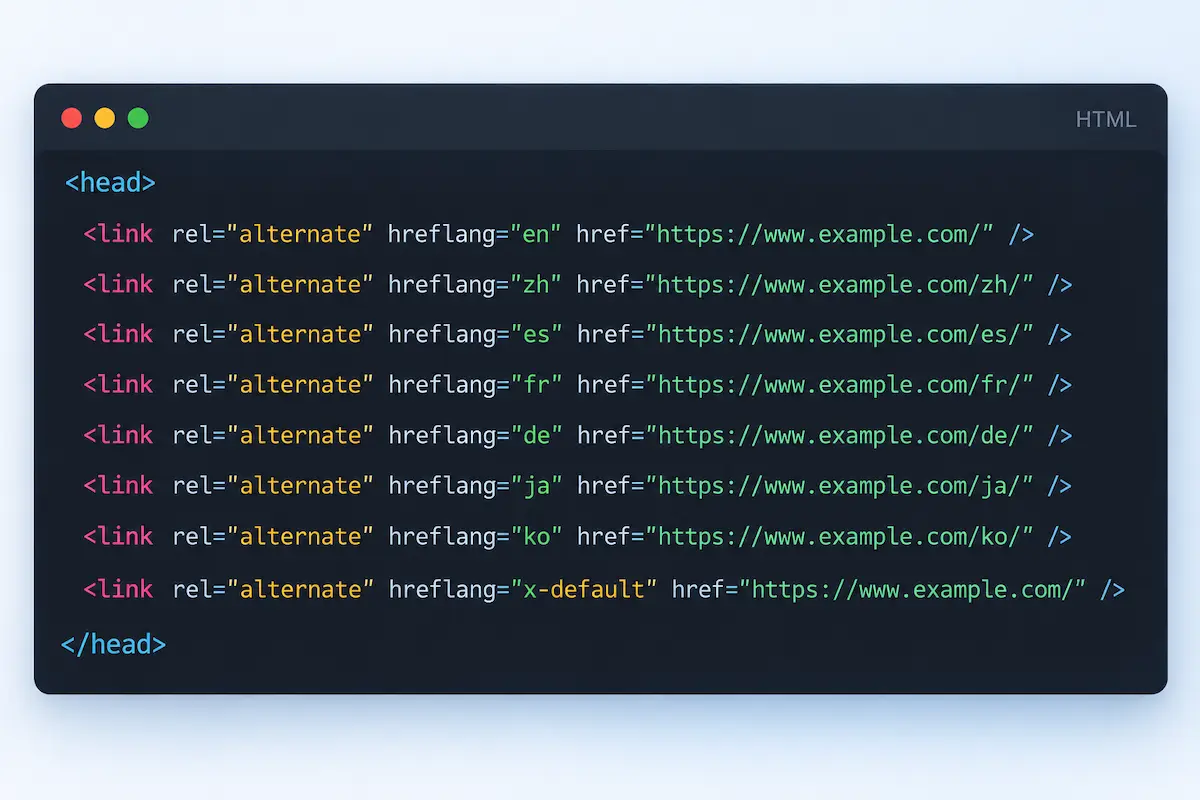
Google officials also clearly stated that multi-language versions should clearly tell Google the pages corresponding to different languages or regions. For fully translated multilingual pages, you can declare different language versions through HTML, HTTP Header or Sitemap, and use hreflang to help Google understand the relationship between these pages.
So, Multilingual SEO is not simply adding a language button.
It actually involves:
Content + URL + hreflang + Sitemap + Internal links + SEO keywords + localized content
This whole system.
What is the difference between English websites and minority language websites?
Many companies will ask:
"I already have an English independent website. Do I still need to add German and Spanish versions?"
You can first judge from the following aspects.
| Contrast dimensions | English independent website | Independent website in small languages |
|---|---|---|
| Primary User | Global English users | Specific language market users |
| Search coverage | English keywords | Corresponding language keywords |
| Market Scope | Guang | More focused |
| SEO competition | Usually more competitive | Some segmented words may have different competitive landscapes |
| Localization level | Relatively limited | Can penetrate into the local market |
| User reading experience | English user experience is better | Native language users can understand more directly |
| Brand localization | Global Expression | Closer to the local market |
| Content Operation | Mainly English content | Need multi-language content system |
| SEO Cost | Relatively concentrated | Need to increase content and maintenance costs |
| Suitable for enterprises | Global market layout | Companies with clear target countries |
One point needs special emphasis here:
Small language does not mean low competition, nor does it mean faster ranking.
SEO ultimately depends on multiple factors such as keywords, content quality, website foundation, external links, brand signals, user needs and competitors.
So, the correct idea for developing small languages is not "If you can't do it in English, just change the language."
Instead:
When a country itself is your target market, create a second search entry in the local language.
Which languages should small language independent websites give priority to?
There is no one-size-fits-all answer to this question.
Different companies have different customer markets and naturally have different priorities.
However, for Chinese B2B foreign trade companies, they can focus on several mature markets.
German
German-speaking markets such as Germany, Austria, and Switzerland have a large number of customers in industry, manufacturing, machinery, automobiles, electronics and other industries.
If your product is primarily aimed at the European B2B market, German is usually worth looking into.
But you should also pay attention here:
The German-speaking market does not mean only doing business in Germany.
If a company wants to cover Germany, Austria, and Switzerland, it needs to further study the market needs and language expressions in different regions.
Spanish
Spanish covers a very wide market.
In addition to Spain, it also involves many countries in Latin America.
Therefore, the potential reach of Spanish-language sites is not just one country.
But there are also obvious regional differences in Spanish.
The business habits, prices, logistics, payment methods and expressions of some products may be different between Spanish customers and Latin American customers.
So, if the company focuses on developing markets such as Mexico, Chile, and Colombia in the future, it can further develop regional content.
French
France is one of the most obvious French-speaking markets, but the French-speaking market also has wider coverage.
If the company's products are related to France, Belgium, Canada or some African markets, then French content may become an important search entry.
Italian
Italy has obvious industrial characteristics in the fields of machinery, industrial manufacturing, furniture, fashion, shoes and clothing, and packaging.
If the company's customers are concentrated in these industries, the Italian website can be a key test direction.
Japanese
The Japanese market usually pays more attention to the professionalism, expression, brand credibility and details of website content.
If a company develops the Japanese market for a long time and only provides an English website, it is often difficult to fully reflect localization.
The Japanese website is more suitable to be a truly independent market entrance for Japanese customers, rather than simply translating the page.
The more websites in small languages, the better
This is a very easy pitfall when building a multi-language independent website.
Some companies say from the beginning:
"I want to do English, German, Spanish, French, Italian, Portuguese, Japanese, Korean..."
Language does a dozen at a time.
The website looks very international.
But after operating for a period of time, I found:
Each language has only a few dozen pages;
The blog is not continuously updated;
Product descriptions are not localized;
No research on SEO keywords;
The inquiry portal is not optimized for local customers.
Finally it becomes:
There are many languages, but none of them are really deep in the market.
For B2B companies, instead of working on ten languages at once, it is better to first select 1 to 3 markets with real business potential.
Then make these language versions deeper.
How to choose the first batch of small languages?
Can be judged from four data:
Where are your existing customers?
If the company has had many German customers in the past three years, then the German version deserves priority.
Because this is not a market selection based on feeling, but has been verified by real business.
Does Google Search Console have data corresponding to the market?
If the English website already has GSC data, you can observe the exposure, clicks and query terms in different countries.
If a country already generates natural search traffic, then there may already be demand in this market.
Adding a local language version at this time will be more targeted than starting the test completely from scratch.
Which countries are the sales team focusing on developing?
If the business team is focusing on developing Germany, France and Spain this year, then the website should be consistent with the sales direction.
The website is responsible for obtaining search traffic, and sales is responsible for converting customers.
If the target markets of both sides are completely inconsistent, investment will be easily dispersed.
Which markets are worth entering?
In the end, you still have to watch:
Search volume + business value + degree of competition + company’s own advantages
Instead of simply looking at the number of languages.
How to design the URL of minority language websites?
There is also a very practical problem with multilingual websites:
How to make URL?
There are three main common methods:
Directory:
example.com/de/
Subdomain name:
de.example.com
Country/region domain name:
example.de
All three solutions can be used, but the applicable scenarios are different.
Option 1: gTLD + subdirectory
For example:
example.com/de/
example.com/fr/
example.com/es/
This is a solution that is easier to manage when many companies build multi-language independent websites.
All language versions are concentrated under the same main domain name.
For enterprises, domain name management is simple, and servers, website systems, SEO data, etc. are also easier to manage in a unified manner.
For companies that are building brand-based independent websites, this is usually a solution worthy of priority.
Option 2: gTLD + subdomain name
For example:
de.example.com
fr.example.com
es.example.com
This structure can also implement multi-language websites.
The multilingual example in Google's official documentation also shows the use of language subdomains, and specifically points out that subdomains like de.example.com themselves do not automatically tell Google what language or region the page should be targeted to, and still need to be configured through explicit language/region signals.
Subdomain names are more suitable for companies that want to manage different markets relatively independently.
For example:
The German team is responsible for de.example.com
The French team is responsible for fr.example.com
Different language versions can even use different servers or operating systems.
Option 3: Country/region domain name
For example:
example.de
example.fr
example.es
The biggest feature of this method is that it has a stronger sense of the local market.
When users see .de, it is easy to think of the German market.
But for global brands, national domain names also mean more domain name management, brand asset management and technical maintenance work.
Therefore, not all companies need to use national domain names.
How to choose among three multi-language URL structures?
| URL structure | Example | Advantages | Insufficient | More suitable |
|---|---|---|---|---|
| Subdirectory | example.com/de/ | Centralized management, clear structure, easy maintenance | Different markets are less independent | Most foreign trade companies |
| Subdomain name | de.example.com | More independence between markets | Technical and SEO management is more complex | Multi-team, multi-market enterprise |
| Country domain name | example.de | Strong sense of localization | Domain name management costs are higher | Strong local brand strategy |
If the company just wants to add German, Spanish, French and other versions to the existing English independent website, it can usually give priority to:
Main domain name + language subdirectory.
For example:
example.com/de/
example.com/fr/
example.com/es/
This is more straightforward for long-term maintenance of the enterprise.
Why is hreflang important?
If a website is available in multiple languages, you need to consider how Google understands the relationship between these pages.
For example:
English:
example.com/product/
German:
example.com/de/product/
French:
example.com/fr/product/
Spanish:
example.com/es/product/
Google needs to know:
These are not four completely unrelated pages, but different versions of the same product for users in different languages.
You need to consider hreflang at this time.
Google officially recommends that multi-language or multi-region pages should clearly declare the corresponding version; each language version usually needs to list itself and other language versions, and maintain mutual correspondence.
For example:
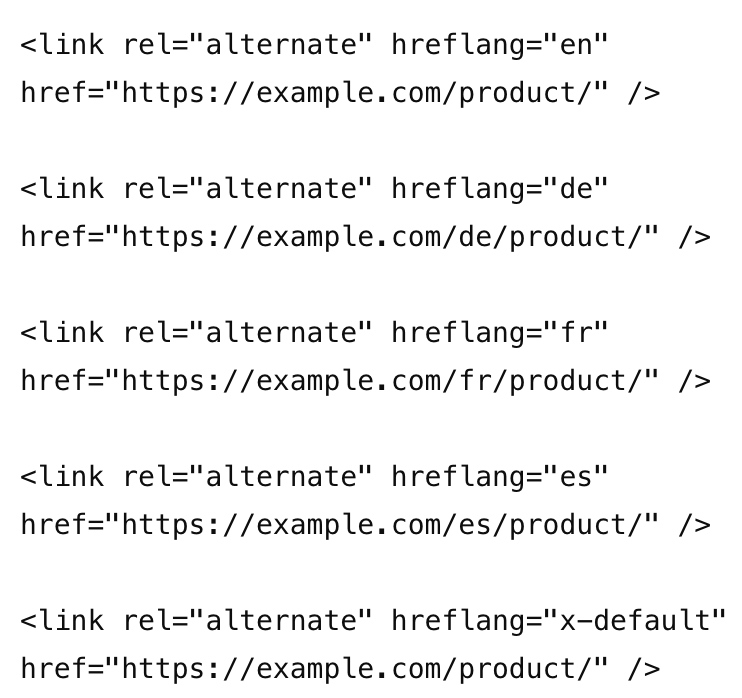
The most important thing here is not to remember the code, but to understand the logic behind it:
Tell Google: This page is available in other languages.
SEO for small languages cannot just translate keywords
This is the most common problem that many companies often encounter when doing multi-language SEO.
For example, English keywords:
custom shoes manufacturer
A direct translation into another language does not mean that it is the actual search term used by local buyers.
What SEO should really study is:
How to search for local customers.
This requires renewed keyword research.
From "translating keywords" to "researching keywords"
A mature small language SEO process should be:
Step one: Determine the target market
For example:
Germany.
Step 2: Research local keywords
Find:
Product words, supplier words, manufacturer words, customization words, procurement words, solution words.
Step 3: Research competing websites
See which sites appear in Google local search results.
Step 4: Analyze search intent
Determine whether the user is at:
Looking for products?
Looking for a supplier?
Compare prices?
Looking for a manufacturer?
Understand technology?
Still ready to purchase?
Step 5: Remake the page
Reorganize content based on local keywords and search intent.
This is multilingual SEO in the true sense.
What is the relationship between small languages and GEO?
If SEO mainly solves:
Let customers find you in search engines.
Then GEO is more concerned about:
Can AI understand your brand when customers use it to search for product, supplier and industry information.
More and more companies are now paying attention to AI search scenarios such as ChatGPT, Google AI search, Perplexity, and Gemini.
For a global brand, if the website is only in English, the language coverage of the brand's public information will also be limited.
Multi-language content can help companies form a more complete brand information system.
GEO needs more than just “translation”
Many companies tend to have a misunderstanding when understanding GEO:
"Can translating articles into ten languages improve GEO?"
No.
The core of GEO remains:
Whether the content is clear, credible, structured, and quotable.
For example, a German buyer asked AI:
"Who are the reliable custom shoe manufacturers in China?"
If your brand website has:
English brand introduction;
German brand introduction;
Product page;
Manufacturing capabilities;
Factory information;
Authentication information;
Case;
FAQ;
Industry content;
Third-party brand mentions;
Structured data;
Clear entity relationship;
Then when AI understands the brand, it can obtain more complete information.
Google also explains that structured data can help search engines understand the content of the page.
So, from a GEO perspective, a multilingual website is not simply about increasing the number of pages.
Instead, it is increasing:
Language coverage of the brand entity.
How can minority language websites improve inquiry conversion?
Traffic is only the first step.
For B2B independent websites, what really matters is:
Are there any valid inquiries?
After a German customer enters the German page, if the entire page has only one English inquiry button:
"Contact Us"
In fact, there is still a certain language barrier.
A better approach is to make the entire conversion path as consistent as possible.
For example:
German product page;
German product parameters;
German FAQ;
German case;
German inquiry button;
German form prompt;
German WhatsApp or email communication instructions.
Customers will more easily understand what to do next.
Which positions should be optimized on small language pages?
Product title
Don’t just translate, but conform to local industry practices.
Product description
Reduce Chinese corporate-style expressions and use more business expressions used by local buyers.
Product parameters
B2B customers care a lot about parameters.
Parameters should be as standardized and structured as possible.
FAQ
FAQ can solve a large number of questions that customers have during the purchasing process.
Case
Case studies are important in building trust.
If there are local customer cases, they should be highlighted.
Contact information
Let customers quickly find:
Email, WhatsApp, phone, inquiry form, etc.
CTA
CTAs don’t need to be complicated.
For example:
Request a Quote
Get a Free Consultation
Send an Inquiry
The most important thing is to let customers know:
What to do next.
5 common mistakes in small language independent websites
Only machine translation
This is the most common question.
Machine translation can help companies quickly create the first version of content, but it is best for core pages to be manually proofread and industry localized.
Especially product names, technical parameters, industry terms and sales expressions.
Do dozens of languages at once
More languages do not mean faster business growth.
What the website really needs is:
Valuable market, not beautiful language quantity.
Only translate the home page
If only the homepage is in German and the product pages are in English, then the localization level of the entire website is still very low.
Really valuable small language SEO should cover:
Home page, products, solutions, cases, blogs, FAQ and other core pages.
Ignore keyword research
It is very dangerous to directly translate English keywords into German or Spanish.
Keywords should be re-researched.
It will not be operated after completion
This is the most unfortunate situation.
Companies spend money to translate their websites, and then do not update them for half a year.
No blog;
No case;
No external links;
No Search Console analytics;
No keyword optimization.
Finally found:
"Why do small languages have no traffic?"
In fact, the problem may not be the language itself, but the lack of continuous operation.
A small-language SEO process that is more suitable for foreign trade companies
If your company is ready to officially launch an independent website in small languages, you can proceed as follows.
Market analysis
Confirm first:
Which country is worth doing?
Don’t ask first:
"German or French?"
Instead ask first:
"Which market is our business most interested in acquiring customers from?"
Keyword analysis
Determine what local customers are actually searching for.
Create:
Product word;
Industry words;
Supplier word;
Manufacturer word;
Solution word;
Long tail words.
Website architecture
Determine the language URL structure.
If it is a unified brand site, you can give priority to:
example.com/de/
example.com/fr/
example.com/es/
Page localization
Don't just translate.
To recheck:
Title;
Meta Description;
H1;
H2;
Product description;
Picture ALT;
FAQ;
CTA;
Internal link;
Schema.
hreflang configuration
Let Google understand the correspondence between pages in different languages.
Google official documentation points out that multi-language pages can declare language/regional versions through HTML, HTTP Header or Sitemap. The three methods are equivalent from the perspective of Google Search. Enterprises should choose the one that is easier to maintain based on their own technical architecture.
GSC data monitoring
Key points to observe after going online:
Impressions;
Clicks;
CTR;
Average Position;
Queries;
Countries;
Pages.
See which keywords are starting to gain exposure.
Continuous content operation
Find the keywords that have already generated exposure, and then continue to expand:
Blog;
FAQ;
Product content;
Case;
Industry Guide.
In this way, small language websites will gradually transform from a "translation website" into a real "customer acquisition website".
What is really worth doing for small-language independent websites is “localized customer acquisition”
Back to the original question:
Is it necessary for foreign trade companies to build websites in small languages?
The answer cannot be simply "necessary" or "unnecessary".
If your customers are mainly from the English market and the English website is not yet ready, there is no need to rush to expand to a dozen language versions.
First lay the foundation of the English website:
Website structure;
Product page;
Google SEO;
Content system;
Inquiry conversion;
Data analysis.
However, if the company already has a stable independent English website and clearly hopes to enter markets such as Germany, France, Spain, Italy, and Japan, then a website in a small language is worthy of serious consideration.
Because it is no longer a "website translation project" at this time.
Instead:
A new market customer acquisition project.
Globalization of English, localization of small languages
When you reach the end of the foreign trade independent website, you will actually find a very interesting thing.
In the past we thought:
English = Global Market.
Now it should increasingly be understood as:
English is responsible for globalization, and small languages are responsible for localization.
English websites help companies build global brand portals.
Small language websites help companies enter the search environment of specific countries.
SEO helps customers find you on Google.
GEO helps search engines and AI better understand your business, products and professional capabilities.
In the end, the purpose of all this work is to return to the most practical thing:
Let customers with real purchasing needs find you and be willing to leave inquiries.
Therefore, the future independent foreign trade website will not necessarily have an advantage if its website has the most languages.
What really matters is:
Have you chosen the right market, used the right language, created the right content, and continued to operate.
If a company has determined that Germany is a key market, then it is more valuable to do a good job in German than to launch ten language versions at once.
If the Spanish market has generated real inquiries, then Spanish products, cases and content can be further added.
If Google Search Console is already telling you that a certain country is generating search demand, then that's a good sign that it's worth investigating further.
This is what small language independent stations should really do.
Write at the end
For foreign trade companies, an independent website is never just a "company official website".
It should be a digital asset that can be continuously accumulated.
English website solves the basic coverage of the global market;
Small language websites solve localized reach of target markets;
SEO solves Google search traffic;
GEO solves brand understanding and information citation in the era of AI search;
Content, cases, structured data, and third-party trust signals jointly help companies establish long-term online competitiveness.
So, if you are planning an independent foreign trade website, you might as well ask yourself three questions first:
In which countries are my customers located?
What language will they use when searching for my products?
Does my website actually cover these search needs now?
Thinking through these three issues and then deciding to make several language versions is often more practical than pursuing "all a dozen languages online" from the beginning.
I am Jiang Helang. I have long been focused on foreign trade independent website construction, Google SEO optimization, GEO optimization and overseas customer acquisition marketing.
We hope that by continuing to share practical experience in foreign trade independent websites, SEO, GEO and overseas customer acquisition, we can help more Chinese foreign trade companies truly make their websites into online assets that can continue to bring traffic and inquiries.