
From handwritten HTML to React + Next.js: What has website development gone through over the years?
From hand-written HTML, PHP, and WordPress to React, Vue, and Next.js, website building has continuously evolved. This article traces the 30-year technological evolution of independent websites and analyzes the differences between WordPress and React+Next.js in terms of SEO, GEO, performance, scalability, and long-term operation, helping businesses choose a website building solution more suitable for their future development.
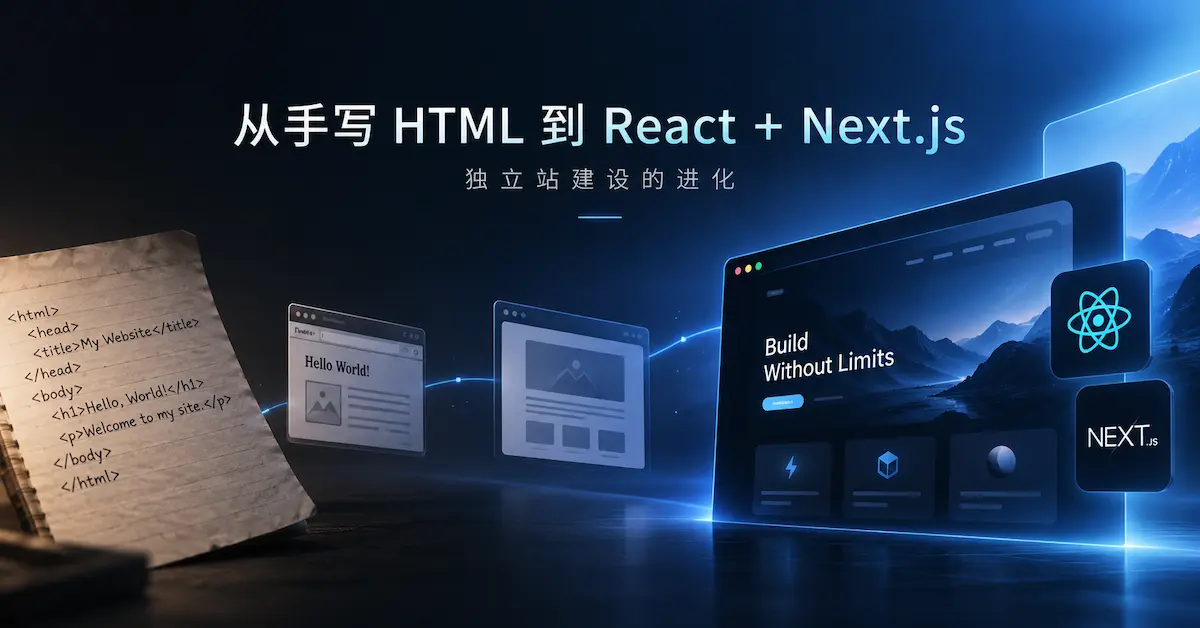
If we extend the development of the internet over a period of more than thirty years, we will find an interesting phenomenon:
A website may still look like a website, but the reasons why businesses build websites have changed significantly.
In the 1990s, a company website might only consist of a few images.Handwritten HTML pageLater, PHP, ASP, Java, and databases enabled websites to have backends.WordPress 等CMS Significantly lowered the barrier to website creation; HTML5, Bootstrap, and jQuery promoted the widespread adoption of responsive websites; React and Vue further...Front-end development enters the era of componentization。
Today, modern web technologies, represented by React and Next.js, are connecting websites with content, SEO, GEO, CRM, data, and AI.
The real changes are not just in programming languages and frameworks.
In the past, when companies built websites, their first consideration was:
"We need an official website."
Today, more and more companies are starting to consider:
"Can this independent website continue to accumulate content, search rankings, brand recognition, inquiries, and customer data over the next three to five years?"
When the problems change, the way we build websites will naturally change as well.

I. Starting with handwritten HTML, the earliest problem a website solved was "being seen."
In the early days of the internet, building a website was a very straightforward process.
One page corresponds to one HTML file.
If a business needs an About Us page, it creates an About page; if it needs Products page, it adds a Products page; and if it needs Contact Us page, it creates a Contact page.
The biggest advantage of this method is its simplicity.
The page has no complex backend and no large number of database requests; a static HTML file can be accessed simply by placing it on the server.
But the problems are equally obvious.
If a company has 100 pages and its phone number changes but is displayed on dozens of pages, maintenance will become extremely difficult.
Adding a product may also mean creating a new HTML file.
Therefore, early websites were more like:
A company brochure posted online.
It solved a very important problem:
For the first time, businesses are able to break free from paper catalogs, trade shows, and geographical limitations, allowing people on the other side of the world to see their products and company information through a browser.
As the internet became commercialized, businesses quickly discovered that simply being able to "watch" was no longer enough.
The website initially needed features such as news publishing, product management, member login, search, forms, and even order processing.
PHP, ASP, Java, and databases thus began to be widely used in website development.
Website from:
HTML file → Browser
become:
Database → Backend Program → Page → Browser
Operations staff no longer need to modify the code every time; instead, they can go to the backend to add products, upload images, fill in parameters, and then the program will generate the page.
From this stage onward, the website transformed for the first time from "a bunch of web pages" into a system that could truly process content and data.
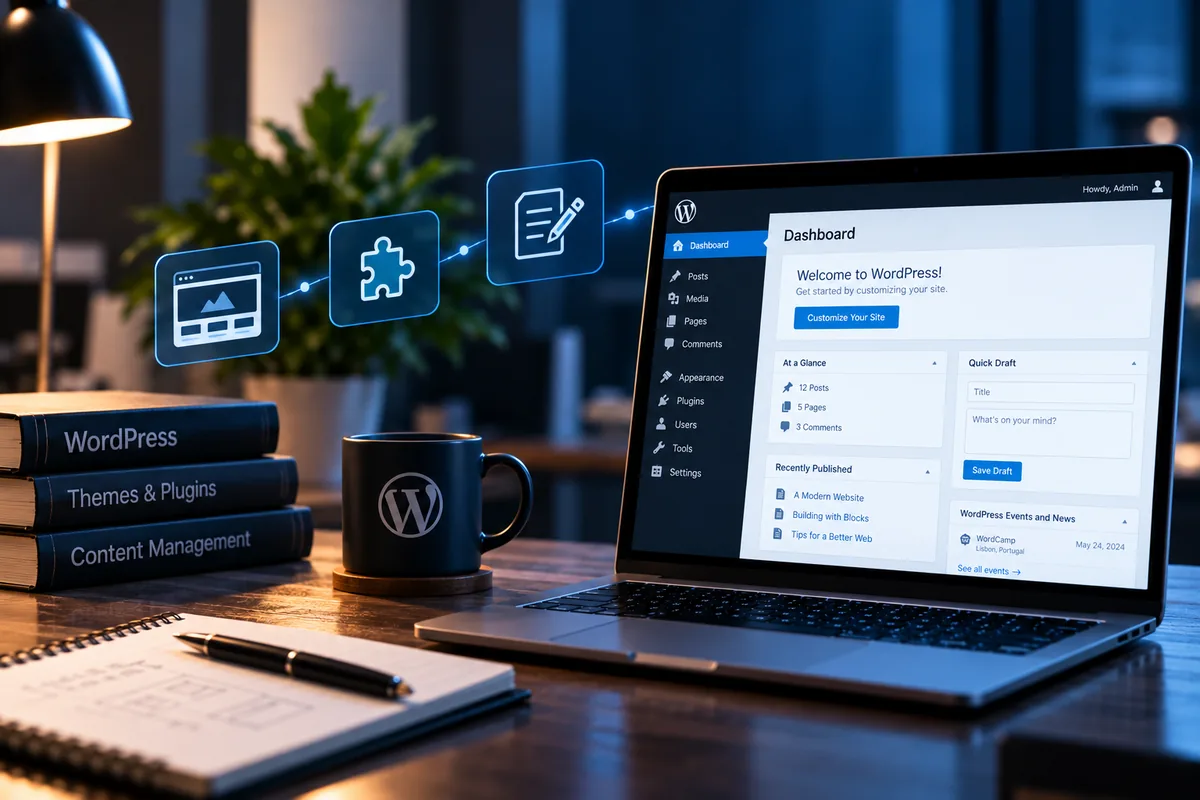
II. WordPress and CMS have truly brought website building into the era of mass adoption.
While dynamic websites solved the backend and data issues, new problems quickly emerged:
Does every company really need to redevelop its news system, image management, user permissions, article backend, and forms?
The answer provided by CMS is:
There is no need for redundant development.
WordPress gained popularity rapidly against this backdrop.
It standardizes a large number of common functions and then expands them through themes and plugins.
As a result, website building began to develop into a very mature model:
Content Management System + Theme + Plugin + Content
For small and medium-sized enterprises, this model greatly reduces the barrier to website construction.
If a business only needs a dozen or twenty pages, including company introduction, products, blog, contact form, and...Basic SEOTherefore, WordPress remains a very practical solution to this day.
This is why we cannot simply say:
After the emergence of React and Next.js, WordPress fell behind.
The choice of technology is not a "battle between the old and the new".
The real problem is:
Does the complexity of the business exceed the range that the original technical architecture is best suited to handle?
However, if the website later requires a large number of customized functions, complex system connections, many plugins, and increasingly large data structures, the maintenance, security, performance, and engineering complexity will also increase accordingly.

Third, with the advent of mobile internet, websites have transitioned from simply being "accessible" to experiencing a superior user experience.
With the widespread adoption of smartphones, website building standards have changed once again.
In the past, websites were mainly designed for computers.
Later, a website had to adapt to:
Computers, laptops, tablets, mobile phones, and different screen resolutions, browsers, and network environments.
HTML5, CSS3, Bootstrap, and jQuery were widely used during this period.
Bootstrap helped developers complete responsive layouts faster, while jQuery reduced the complexity of JavaScript DOM manipulation and interactive development at the time.
Website building issues begin with:
"Can you open it?"
become:
Is it easy to use?
This is especially important for independent foreign trade websites.
An overseas buyer might spend the morning in the office searching for suppliers on their computer, the afternoon at a trade show looking at products on their phone, and the evening reading technical documents on their tablet.
If a website looks great on desktop but has issues on mobile, such as small fonts, slow images, difficult-to-use menus, and hard-to-fill RFQ forms, then even if Google brings in traffic, it may not generate inquiries.
Therefore, let's discuss this again today.Foreign trade independent website constructionMobile user experience is no longer a bonus, but a basic capability.
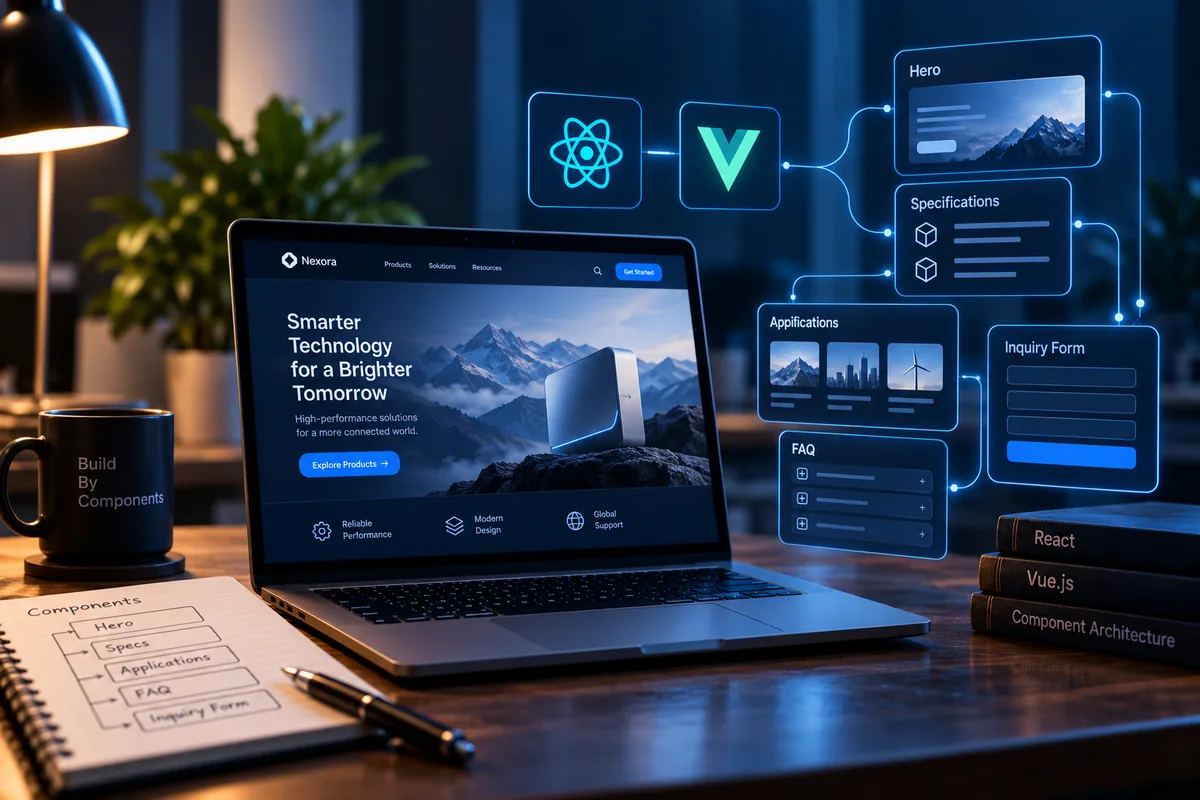
Fourth, the real change brought about by React and Vue is that websites are beginning to be "component-based".
As websites grow from dozens of pages to hundreds or thousands of pages, page-based development begins to encounter new problems.
Suppose a B2B website has:
Product Center, Product Filtering, Parameter Comparison, Case Studies, RFQ, Download Center, Multilingual Support, Membership, CRM, and Online Quotes.
If each page is created and maintained independently, the project will become increasingly complex.
The component-based approach introduced by React and Vue has changed this pattern.
For example, a product details page can be broken down into:
Product highlights, specifications, applications, quality control, certifications, FAQs, related products, and inquiry forms.
These modules can be reused repeatedly.
If a company has 500 product pages, and all products use the same RFQ component, then a single modification can upgrade all 500 pages together.
The website starts from:
Page-based websites
Turning point:
Component-based applications
This is also an important foundation for the continuous expansion of modern independent websites.
At the same time, headless architecture is beginning to receive more attention.
Traditional CMS systems often combine the backend, data, and page templates together.
Headless then breaks them down:
CMS or database responsible for contentReact/Next.js is responsible for the front-end presentation, with connections made via API or GraphQL.
In this way, a single product data set can no longer serve only one website, but can also be used by CRM, APP, distributor systems, and even AI Agents.
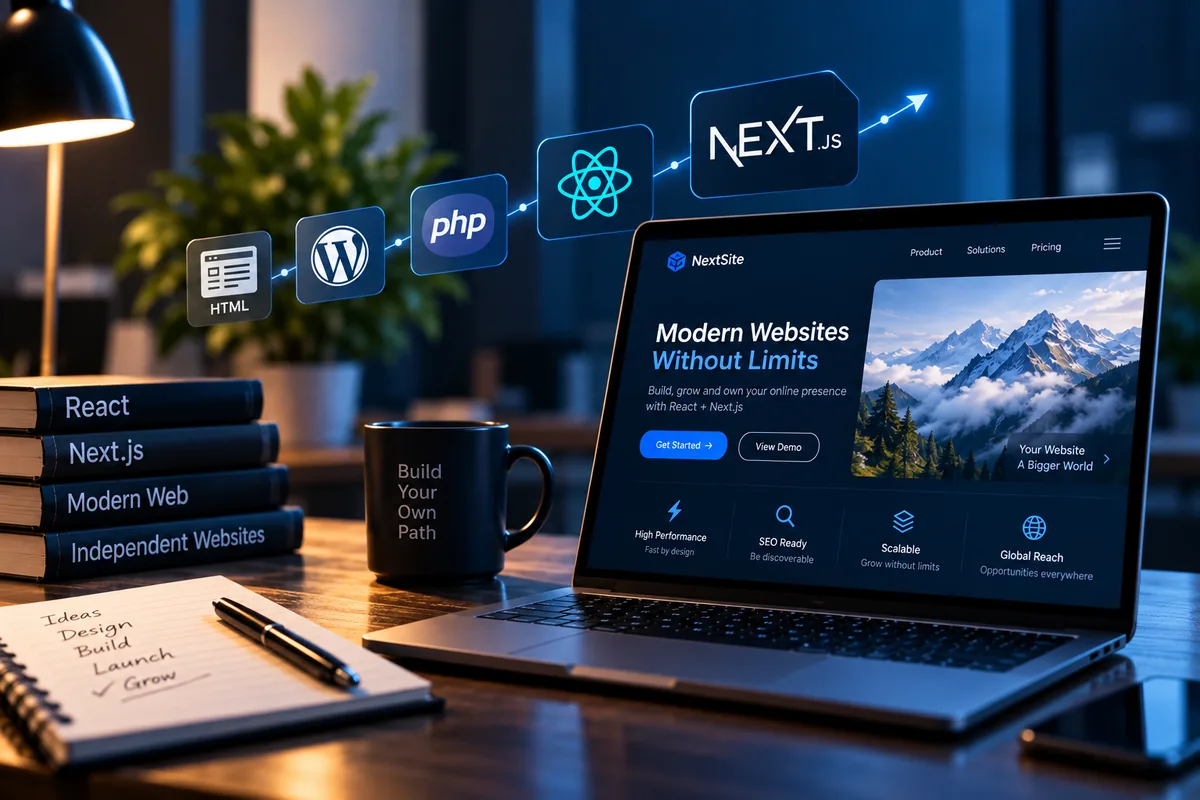
V. Why has React + Next.js become an important route for modern independent websites?
React excels at handling componentization and complex interactions.
However, if a company's website still relies on Google for organic traffic, then simply solving the front-end interaction is not enough.
The website still needs to be processed:
Search engine crawling, page rendering, metadata, sitemap, canonical, schema, multilingual support, images, caching, server-side data, and page performance.
The value of Next.js lies here.。
It can be simply understood as:
React is responsible for building the UI and components, while Next.js provides a more complete website and web application framework capability on top of React.
Therefore, React + Next.js is not for "making the page look more fancy".
What it truly solves is:
As websites become increasingly complex, how can we simultaneously balance development efficiency, page performance, SEO, and long-term scalability?
The development of website construction over the past thirty years can actually be summarized as follows:
| stage | Representative technologies | Problems to be solved | Website Role |
|---|---|---|---|
| 1990—1995 | HTML | Information launched | Online Brochure |
| 1996—2004 | PHP / ASP / Java | Dynamic functions, backend | Information systems |
| 2005—2012 | WordPress/CMS | Lowering the barrier to website creation | Content Management Platform |
| 2013—2017 | HTML5 / Bootstrap / jQuery | Mobile and responsive | Marketing website |
| 2018—2021 | React / Vue | Componentization, complex interactions | Web Applications |
| 2022—2026 | React + Next.js | Full-stack, SEO, performance, scalability | Digital Business Platform |
Every technological change does not mean that the previous generation of technology suddenly becomes obsolete.
More accurately, businesses are taking on more and more responsibilities for their websites.
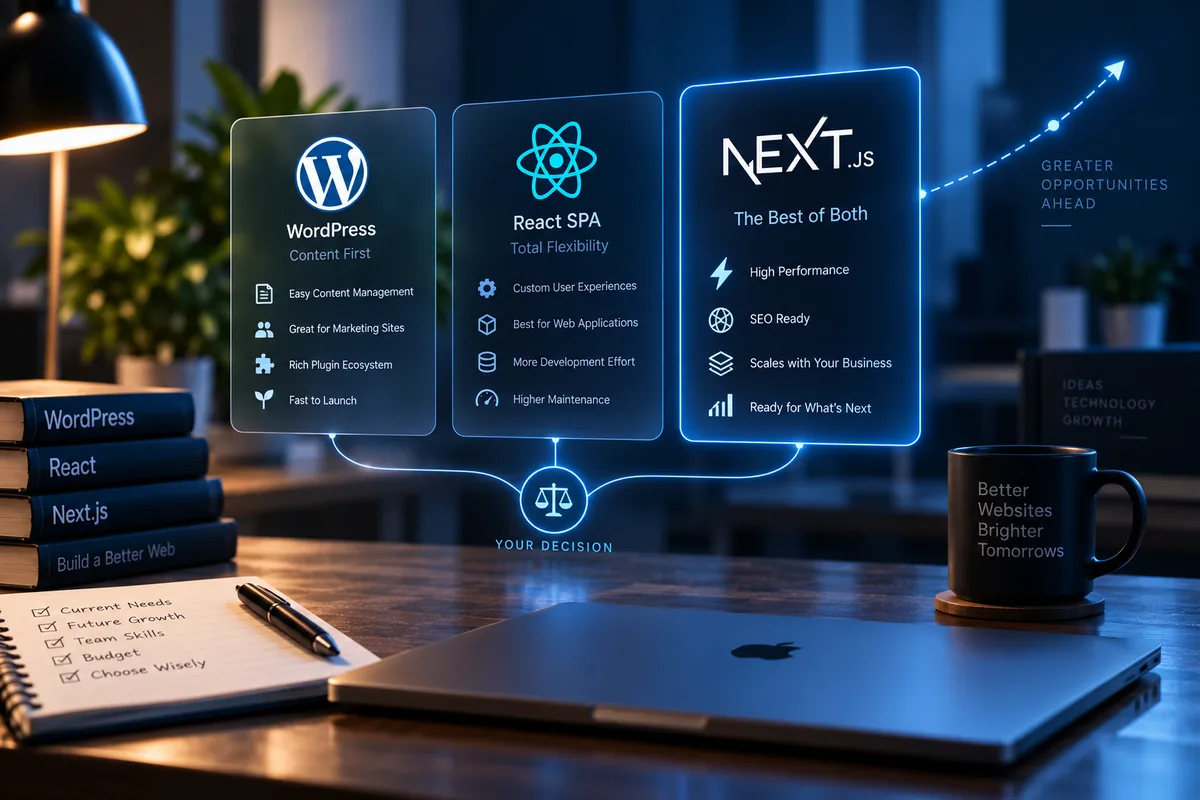
6. Whether to use WordPress or React + Next.js depends on how the website will look in three years.
If a company only needs:
For 10-20 pages, product showcases, news blogs, contact forms, and basic SEO, WordPress is perfectly adequate.
The real technological gap often emerges after a website has been operating continuously for several years.
A newly launched independent e-commerce website might only have:
30 pages + 100 products.
Three years later, it may have become:
500 products + 100 categories/application pages + 2000 pieces of content + multilingual support + CRM + RFQ + SEO/GEO + automation.
At this point, the problem to be solved is no longer just creating pages.
Businesses are starting to care:
Can product data be managed in a unified manner?
How many systems need to be modified to add a new language?
Can the schema be generated automatically?
Can inquiries be processed through CRM?
Can the AI Agent directly access the product knowledge base?
Can the website continue to expand with new business functions?
The differences in technology choices will gradually become apparent here.
| Dimension | WordPress | React Single Page Application | React + Next.js |
|---|---|---|---|
| Launch speed | quick | Slower | medium |
| Initial costs | Low to Medium | Middle to High | Middle to High |
| Content Management | Mature | Typically, a CMS is required. | Can be connected to Headless CMS |
| Customization freedom | higher | Very high | Very high |
| SEO technology control | Mature | Additional processing required | Very strong |
| Server-side content output | PHP server | Default is client-oriented | support |
| model | Plugin/Development | Self-developed | Highly controllable |
| API/CRM | Plugins/APIs | powerful | powerful |
| Complex business expansion | Customization/Plugin | Very strong | Very strong |
| Long-term engineering | Depending on the project | powerful | powerful |
Therefore, truly professional technical judgment should not be:
Which framework is the best?
Instead, it should be:
To what extent does the company plan to develop this independent website?

VII. Independent website SEO is no longer just about "publishing articles and manipulating keywords".
Website technology is changing.SEO itself is also changing.。
Many companies still regardIndependent website SEO optimizationUnderstand as:
Find keywords, write articles, and build backlinks.
However, for B2B companies, the content that truly has commercial value is increasingly closer to the complete procurement decision-making process.
For example, a CNC factory should not repeatedly write articles around the keyword "CNC Machining".
Also needs to be covered:
product
CNC milling, CNC turning, five-axis machining, CNC machining of aluminum materials.
application
Automobiles, robotics, medical, aerospace.
Procurement issues
What is the cost of CNC machining in China?
What is the minimum order quantity for custom CNC parts?
How to choose a CNC machining supplier?
Decision Comparison
CNC machining and die casting.
Aluminum alloys 6061 and 7075.
Three-axis CNC machining and five-axis CNC machining.
Once this content is linked through products, categories, internal links, and knowledge centers, what a company owns is no longer just a bunch of blogs.
Rather, it is a system built around procurement decisions.Industry Knowledge Network。
For independent websites, the long-term value of this content system far outweighs simply pursuing "how many articles were published today".

8. After the emergence of GEO, website content also needs to be made easier for AI to understand.
AI search has brought about another significant change:
Users are increasingly moving away from simply entering a few keywords and starting to ask complete questions.
A traditional search might be:
Chinese industrial pump manufacturers
In AI search, users might directly ask:
Which Chinese industrial pump manufacturers can provide OEM services to European distributors?
The latter already includes the product, country, supplier type, OEM capabilities, and target market.
This meansGEO optimization for independent websitesWe need to pay more attention to the completeness of the content expression.
For example, many corporate websites like to write:
We are a professional manufacturer offering high-quality products at competitive prices.
This statement is not wrong, but it provides very little information.
If the page provides it directly:
With information on MOQ, delivery time, materials, certifications, voltage, dimensions, test data, customization capabilities, export markets, and real-world case studies, it becomes easier for buyers, search engines, and AI to understand what a company can actually do.
SEO and GEO are not two completely separate systems.。
A website with a clear technical structure, authentic content, crawlable pages, and well-defined entity relationships is itself laying the foundation for both.

9. In the AI era, what's truly scarce isn't articles, but rather the evidence provided by the companies themselves.
Generating an article on "How to Choose a Reliable Supplier" is very easy these days.
Therefore, the scarcity of ordinary information itself is decreasing.
What makes a company truly difficult to replicate is:
Production line photos, actual parameters, testing equipment, test reports, certifications, MOQ, delivery time, materials, processes, customer cases, engineer experience, and export data.
This kind of content should become the core assets of future B2B independent websites.
| Content hierarchy | Main content | Problems to be solved |
|---|---|---|
| Product Content | Parameters, Model, Material, Application | What exactly do companies sell? |
| Professional content | Technical articles, selection, comparison | Is the company professional? |
| Evidence content | Factory, testing, certification, case studies | Why it's trustworthy |
| Content conversion | MOQ, delivery date, samples, RFQ | How to start a collaboration |
Structured data such as schemaThe meaning of this should also be understood within this logic.
Schema can help machines more clearly distinguish information such as Organization, Product, Article, Breadcrumb, and FAQ, but it is not a button that "automatically improves ranking after being added".
If the content itself is empty, simply adding structured data cannot replace the value of real information.
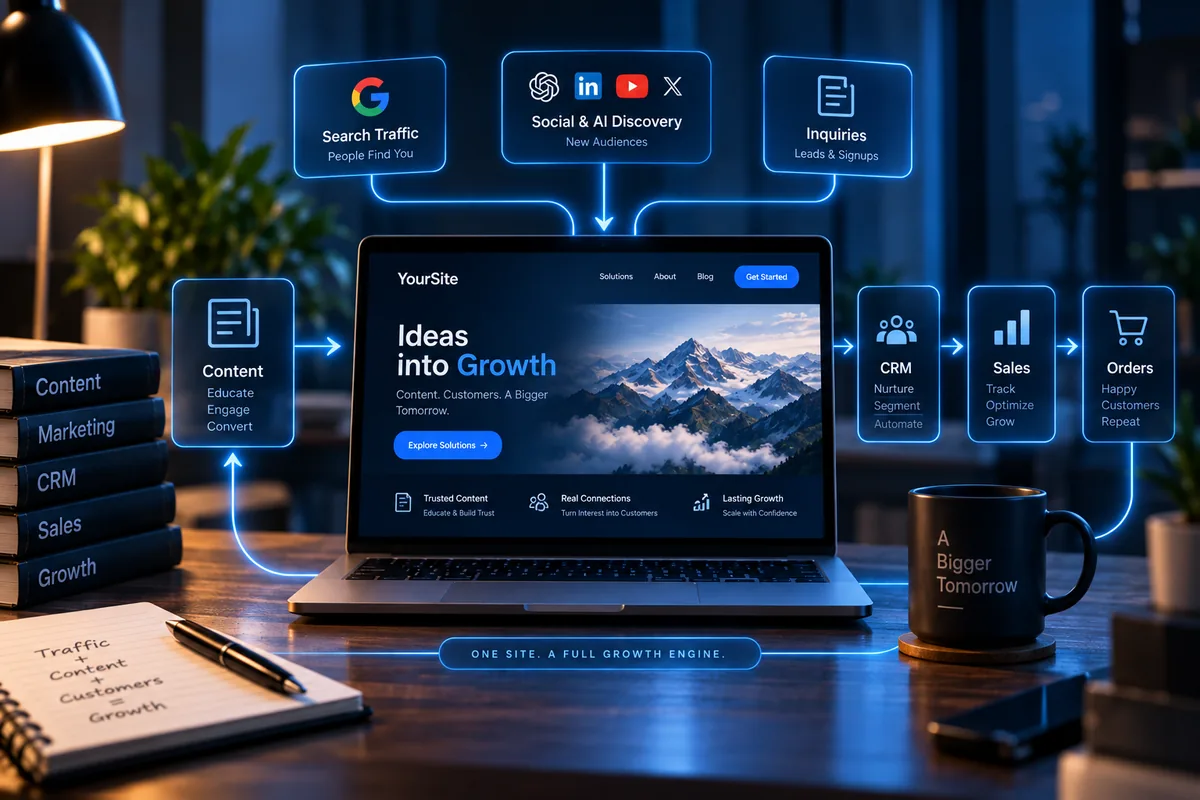
10. The future of independent websites is transforming them into essential infrastructure for business growth.
In the past, the typical process for creating a corporate website was very simple:
Visit the website → Fill out the form → Receive an email → Sales reply.
This link can be further developed into:
Google/AI/Social → Website → Product/Content → Inquiry → Customer Relationship Management → Email/WhatsApp → Sales → Orders
Websites are no longer just the end point of display.
It gradually became:
A connection layer between traffic, content, data, customers, and sales.
Going forward, companies may incorporate AI to assist in content production, inquiry classification, customer profiling, email responses, product recommendations, knowledge base Q&A, and sales follow-up.
This also means that when assessing website construction costs, businesses cannot simply ask:
How much does it cost to build this website for the first time?
It should be calculated that:
Total cost of ownership for the next three to five years.
Development, servers, security, plugins, maintenance, SEO, GEO, content, redesign, system connectivity, and subsequent feature expansion all constitute the real costs of a website.
A website that is cheap in the first year may not be cheap in the long run if it has to be completely rebuilt every time it is upgraded.
A website that requires a higher initial investment but has reusable components, unified data management, and continuously expandable APIs may actually have more controllable long-term costs.
From handwritten HTML to WordPress, and then to React + Next.js, the biggest change over the past thirty years has not been "the code becoming more and more advanced".
Instead, the tasks undertaken by websites are becoming increasingly important.
Initially, it solved the following problem:
Let others see the company.
The solution was later found:
Let companies manage their own content.
The solution was later found to be:
To provide a better experience for different devices.
Let's start resolving this today:
How to continuously acquire search traffic, accumulate content, connect customer data and business systems, and prepare for the AI era.
Therefore, when a company builds an independent website today, what it should really consider is not:
WordPress or Next.js?
Instead:
Three years from now, will this website still be able to support the company's business growth?
If a website can continuously accumulate products, content, rankings, brand, data, and customer relationships, then it is no longer just an "official website".
It began to become something that the company truly owned.Long-term digital assets。
XI. Make independent websites truly long-term growth assets.
Website building has evolved from "creating a page" to "building a long-term growth infrastructure".
For businesses, what truly matters isn't simply choosing between WordPress, React, or Next.js, but rather figuring out: what will they be using in the next three to five years?How many products, how much content, and how many languages does the website need to support?And whether to continue connecting SEO, GEO, CRM, data, and AI.
If your business is preparing to build a new independent website, or your existing website is already experiencing problems...Slow speed, weak SEO foundation, difficulty in content expansion, inability to integrate the system, and stagnant growth in inquiries.Questions and other issues can be discussed with Looking for clues Let's chat.
SeekClue focuses on building independent corporate websites and long-term digital growth.。
We focus not only on "launching the website," but also on helping businesses start with website architecture, and:
Brand showcase, product content, SEO, GEO, inquiry conversion, data accumulation, and subsequent system expansion.
Include them in the same long-term plan.
If you're unsure whether WordPress or React + Next.js is a better fit for your business, or whether your existing website needs a complete overhaul, feel free to send us your current website and business situation.
SeekClue can help you determine the next steps by starting with your website's current status, technical architecture, SEO/GEO fundamentals, and future business needs.
A good independent website should not only be usable today.
It should continue to help businesses be found, understood, and trusted in the coming years, ultimately bringing in more customers.
SeekClue | Making your website a digital asset for continuous business growth.