
For independent e-commerce websites, why are customers, Google, and AI indispensable?
GEO (Google SEO) doesn't guarantee that AI will recommend your website, nor does it directly guarantee customer clicks, inquiries, or sales. For independent e-commerce websites, truly effective website construction needs to consider three dimensions simultaneously: customer experience, Google SEO, and AI GEO. Customers care about whether the website is clear, professional, and easy to convert; Google focuses on search demand, keywords, content quality, and EEAT (External Evidence, Authorization, and Acquisition); AI places greater emphasis on structured data, content understanding, and external sources. Meanwhile, brand and domain name are also crucial assets that cannot be ignored in the long-term accumulation of a website.

Technology is advancing, the times are accelerating, and we are all running at full speed. The ways in which foreign trade acquires customers are also changing, and customers are finding new ways to find suppliers. (AI Search/Q&A)
At this point, many people began to pay attention to GEO . Some might ask:
If I implement GEO on my website, will AI recommend it to me? Will it definitely bring in customers?
My answer is, it's not that simple.
Implementing GEO (Geometric Optimization) definitely makes a difference in a website's performance in AI search. Structured data and external information sources are particularly important.
Conversely, if you don't specifically create a GEO, does that mean AI will never reference your website? Not necessarily.
If a website has good SEO , a solid content base, and a well-structured keyword strategy, then AI may also use that website. This is because many AI programs now refer to content found by search engines when acquiring information. Therefore, even without GEO (Google AdSense) optimization, a website can still gain some exposure from AI.
However, after implementing GEO, we can further optimize how AI understands and references content, making it easier for AI to recognize, understand, and extract information from the website.
Furthermore, even if you use GEO, there's no guarantee that a customer will click on it, let alone that a sale will be made.
Why? Because this already falls under the category of customer behavior.
AI recommending your website only means that customers have the opportunity to see it. Whether a customer will click on it, continue browsing, send an inquiry, or ultimately make a purchase depends on many other factors.
Therefore, when building an independent website for foreign trade, you can't just focus on whether AI is using it. What you really need to do is make the website itself more professional. And I believe this " professionalism " should meet at least three dimensions simultaneously.

From the customer's perspective, make the website better.
The most direct criterion is whether a user can find the content and service they are looking for within 3 seconds of entering the website. This is actually very important.
Overseas customers visiting a website won't patiently study its page structure. If it takes forever to load, or if the homepage is cluttered with complex content, customers won't know what you do or find the products they're looking for, and they might just leave.
Therefore, a website must first address several fundamental issues. Loading speed must be fast, the page layout must be clean, and the information must be clear. Product pages shouldn't just contain a few pictures and a very simple product description. Product information should include relevant parameters, specifications, descriptions, and content that demonstrates professionalism .
Why? Because when customers learn about you through your website, they are also judging whether you are a professional supplier. The more complete your website content and the clearer your product information, the easier it is for customers to build trust.
Ultimately, from the customer's perspective, it's not about technical specifications. What they want to know is:
What exactly do you do? Can you solve my needs? Are you a professional in product knowledge? Are you someone I should contact?
The website needs to answer these questions clearly.
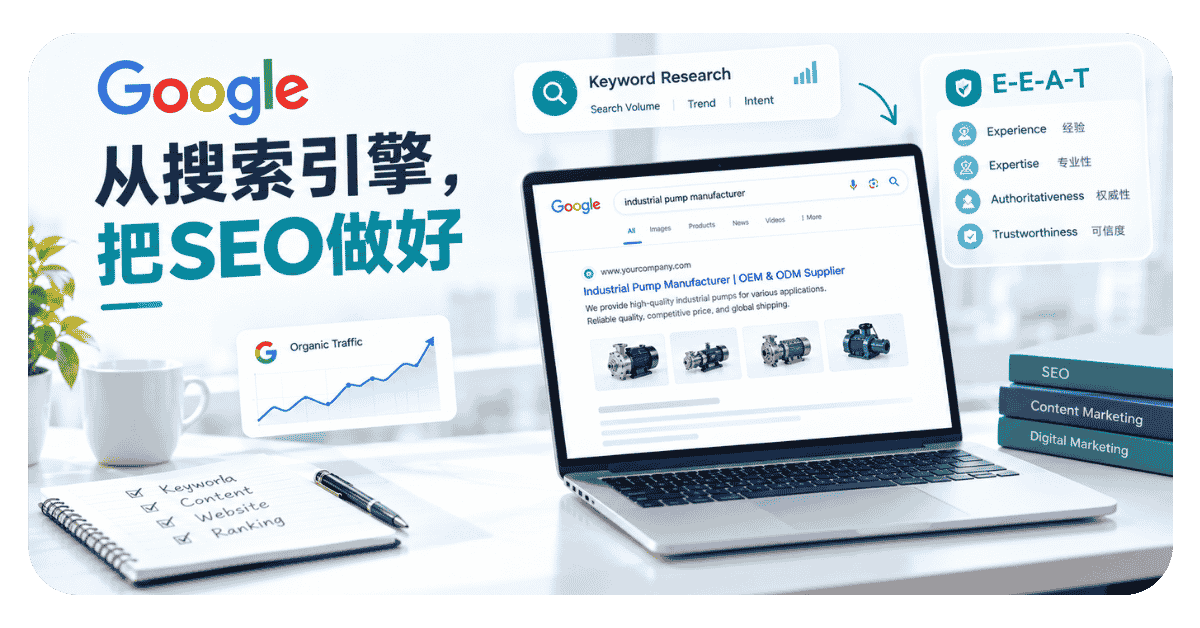
Doing SEO well starts with search engines.
The second dimension is Google, which everyone should be familiar with.
When building an independent website, it's essential to understand Google's rules. For example, the frequently mentioned EEAT stands for Experience, Expertise, Authority, and Credibility.
This information is not written for SEO tools, but ultimately to help search engines make better judgments:
Does this website have any value? Is this company a true participant in this industry?
In addition, keywords should be studied.
You can't just focus on a keyword because you think it's important. You still need to look at keyword popularity, search volume, trends, and what users are actually searching for.
Because SEO essentially solves one problem:
What customers search for on Google, and whether our website has a chance to appear in their search results.
Therefore, at the Google level, the core is to combine search demand, keywords, content, and the website itself for optimization.
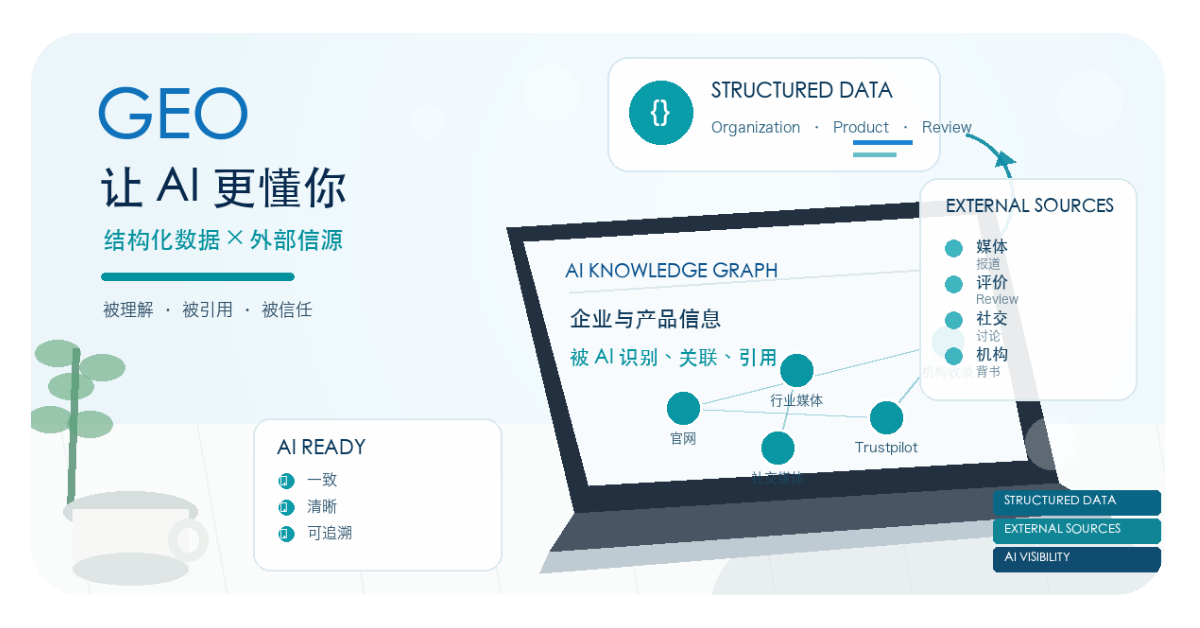
From an AI perspective, how to do GEO well
GEO, simply put, makes it easier for AI to understand your website, your business, and your products. Two key points mentioned at the beginning are worth noting: structured data and external information sources .
Structured data helps AI and search engines better understand what a page actually is.
External sources, on the other hand, are telling the AI:
This company, this brand, and this product don't just claim to be professional on their website; their information can also be found elsewhere.
External sources include, but are not limited to:
Industry media and organizations include it in their databases, external links, Trustpilot, social media, and more.
This information collectively constitutes an enterprise's information network on the Internet.
Therefore, creating a website now is no longer simply about piling all the content onto your site. There's a difference between claiming to be a professional company and having information about you readily available elsewhere on the internet. This is why people are starting to value GEO (Geometric Organization).
These three dimensions are indispensable.
If you ask me how to run an independent e-commerce website right now, I think it mainly comes down to these three dimensions: customers, search engines, and AI .
Customers focus on experience and professionalism. Google focuses on search demand, content quality, and rules like EEAT. AI focuses on whether information can be understood and whether there is sufficient structured data and external sources to support it.
These three directions are all essential. If you only focus on one, you'll have obvious weaknesses.
If you only consider the customer experience, your website may look great, but Google won't be able to find it.
If you only consider SEO, you might get a ranking on Google, but customers won't understand it and won't be willing to make inquiries.
If you only consider GEO, AI might be able to understand you, but if the final customer enters the website and finds incomplete product information and a poor page experience, it will be difficult to generate conversions.
Therefore, if you really want to make a good website, you need to have all of these.
The value of domain names cannot be ignored.
Besides the three dimensions mentioned above, there is another thing that is easily overlooked: brand .
For a website to grow and thrive in the long run, it ultimately comes down to its brand. This is why a good domain name is a crucial asset for many businesses. This is why some people are willing to spend tens of thousands or even more to buy a good domain name. The logic is simple: a good horse needs a good saddle.
A good domain name makes it easier to build a brand and easier for customers to remember. You can't just pick any domain that can be registered. Websites can be continuously upgraded, content can be continuously added, SEO can be continuously improved, and GEO can be continuously optimized, but a brand and domain name often stay with the company from the very beginning.
One thing we've been thinking about is how to make the website more professional.
By now, you should have your own answer! If you found this helpful, please follow us and share it with your friends in the foreign trade industry!
Conclusion
For today's independent e-commerce websites, customer experience, Google SEO, and AI GEO are no longer three independent options, but rather three components that together constitute the website's growth capabilities.
Customers determine whether you can retain visitors, Google determines whether customers can find you, and AI is becoming the new information gateway.
The brand and domain name determine who ultimately owns this long-term accumulation.
SeekClue helps foreign trade companies truly build websites that are understandable to customers, search engines, and AI.