
Why is GEO (Geometric Origin) so important when building an independent website in 2026? You need to understand these 5 metrics.
GEO makes independent websites easier for AI to crawl, understand, reference, and trust, becoming an important customer acquisition portal for foreign trade enterprises in the AI era.
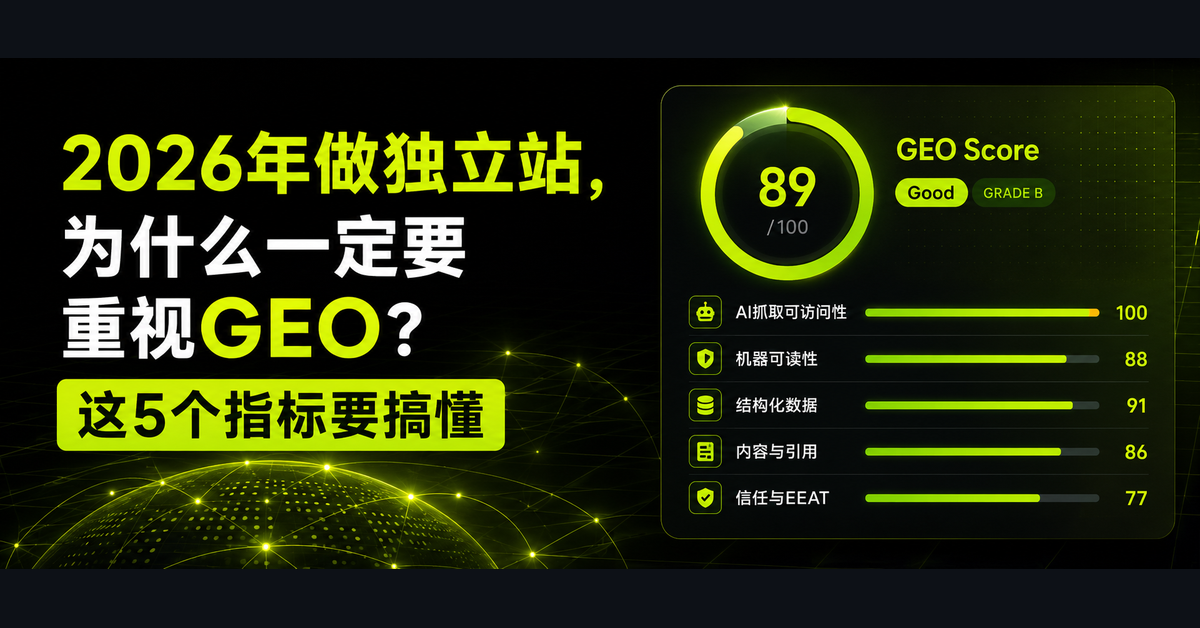
If you're building an independent website in 2026 and your core focus is still on whether Google will index it and whether your keywords will rank, then you're going to fall behind!
With the rapid development of AI, the way overseas customers obtain information is also changing. They are starting to use AI tools such as ChatGPT and Gemini directly to find suppliers, learn about products, and compare brands.
This means that when businesses create independent websites, they cannot only consider whether search engines can understand them, but also whether AI can crawl, understand, judge, and reference them.
This is what I wanted to say: why is it so important to focus on GEO when building an independent website?
GEO makes independent websites easier for AI to crawl, understand, reference, and trust, becoming an important customer acquisition portal for foreign trade enterprises in the AI era. When implementing GEO for an independent website, focus on the following five metrics.
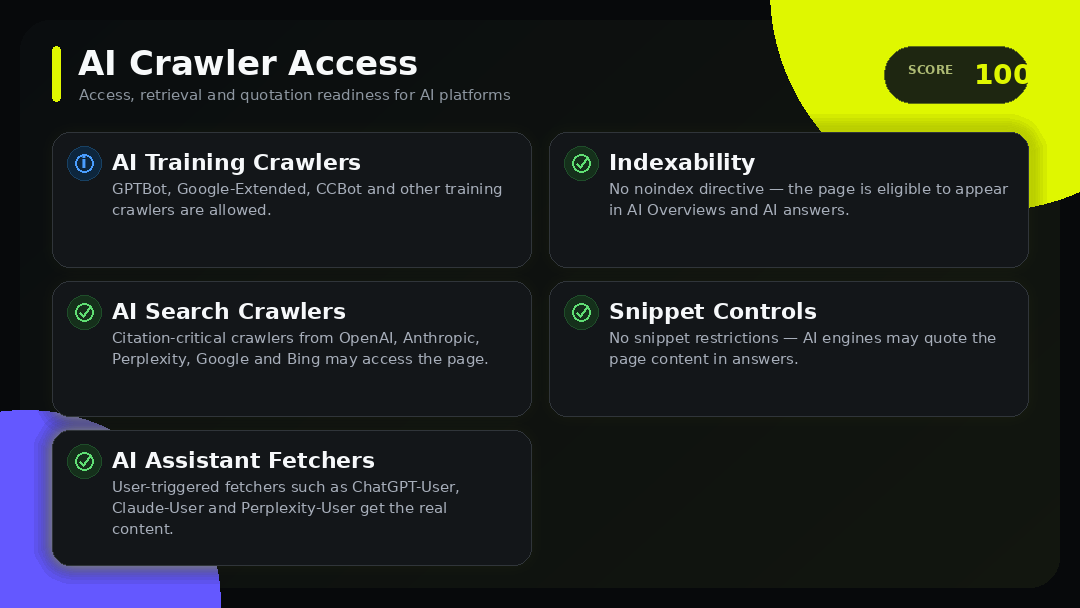
1. AI Crawler Access: Enabling AI to access your website
For AI to understand your business and products, it first needs access to your website content. Therefore, your website needs to be properly configured with robots.txt, crawler permissions, and related access rules, ensuring that important pages are not blocked from AI crawlers. Additionally, pay attention to directives like `noindex` to avoid preventing AI from reading or referencing page content due to incorrect configuration.
This section addresses a fundamental question: can AI find you, access your website, and read your content? If this step isn't done well, subsequent content optimization, structured data, and brand building will all be affected.
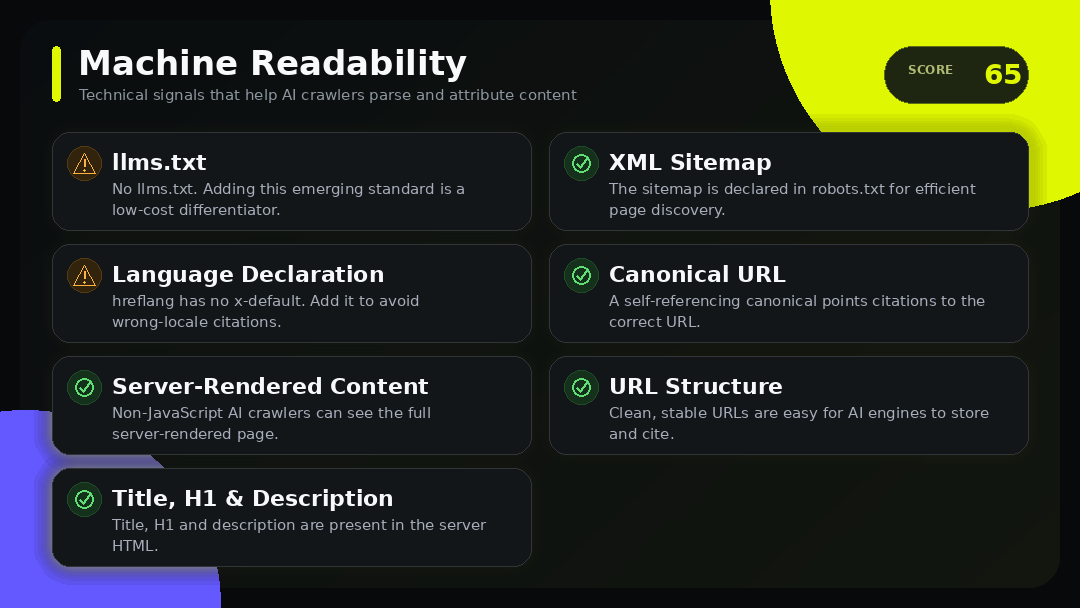
II. Machine Readability: Making your website easier for machines to understand.
AI's ability to access websites doesn't necessarily mean it can quickly understand them. Many independent websites now use JavaScript and dynamic rendering technologies; users can open the pages without problems, but search engines and AI systems may need more time and resources to parse them. Therefore, GEOs need to focus on the machine readability of websites.
Canonical helps search engines and AI determine which URL represents the primary version of a page, reducing information fragmentation caused by duplicate pages. Server-side rendering allows important content to appear more directly in the HTML, reducing reliance on JavaScript execution.
A sitemap helps AI and search engines discover important pages on a website. Language declarations help the system determine the language and region of a page. The URL structure needs to be clear and stable, making it easier for machines to understand the relationships between pages.
Additionally, llms.txt is not currently a mandatory standard for all AI platforms, but as supplementary information, it can help AI more easily understand the important content and resources of a website. The core point here is: don't just consider whether it looks normal to the user, but also whether it's easy for the machine to read.
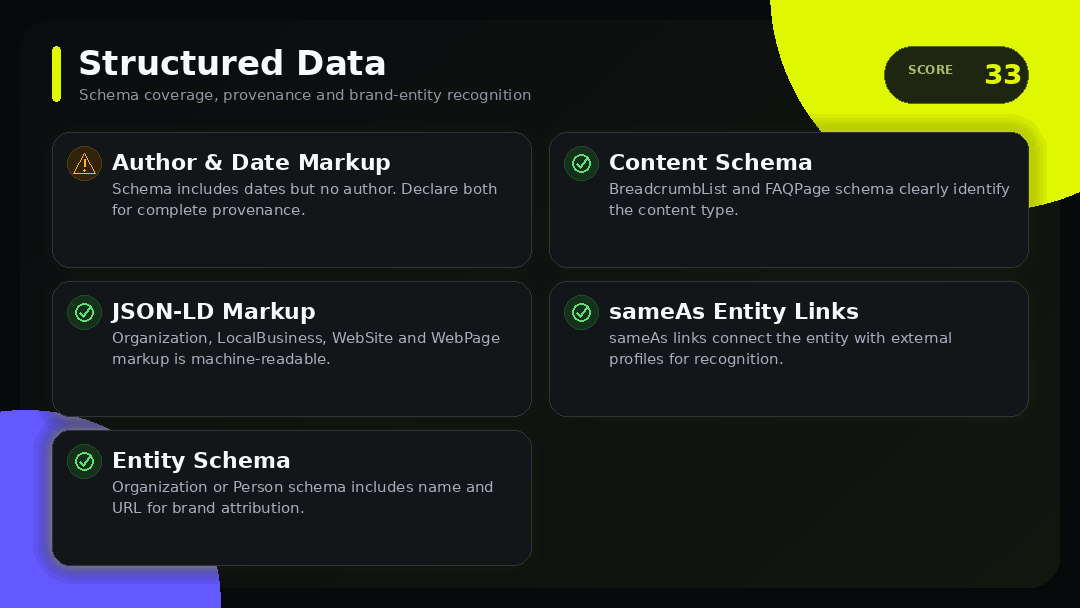
III. Structured Data: Enabling AI to Know "Who You Are and What You Have"
The text on web pages is primarily written for human readers. However, AI needs to further understand what each piece of information represents, which is the significance of structured data.
By using JSON-LD and Schema, we can further inform search engines and AI: What kind of company is this? Who owns this website? What is this brand? What type of page is this? What is this product? Who wrote this article? When was it published?
The clearer this information is, the easier it is for the machine to establish the correct entity relationships. For B2B companies, the relationships between company identity, brand, products, authors, and websites are crucial. This is because AI not only needs to understand your webpage content, but also needs to determine who this content belongs to and whether it has a clear source.
Therefore, structured data is not meant to make web pages look more complex, but rather to express the important information on a website in a way that machines can accurately understand.
IV. Content & Citability: Make your content valuable enough to be cited by AI
GEO ultimately comes down to content. But this doesn't simply mean writing more articles or stuffing keywords. What really matters is whether your page contains clear, specific, and easily extractable information.
When AI answers user questions, it needs to search through a large number of web pages for content that supports the answer. Therefore, website content needs to be more direct. Titles should be clear, the structure clear, answers complete, and key information easily found. At the same time, adding data, facts, parameters, industry knowledge, purchasing information, product information, and professional judgment can give the page a higher density of authentic information.
Question-based titles are also valuable because they closely reflect the actual questions users ask. Lists and tables similarly help AI quickly extract key information. Most importantly, keep your content straightforward. Answer the user's questions; clearly explain the information the AI needs. This is how content is gradually shifting from "written for ranking" to "written to be understood and cited."
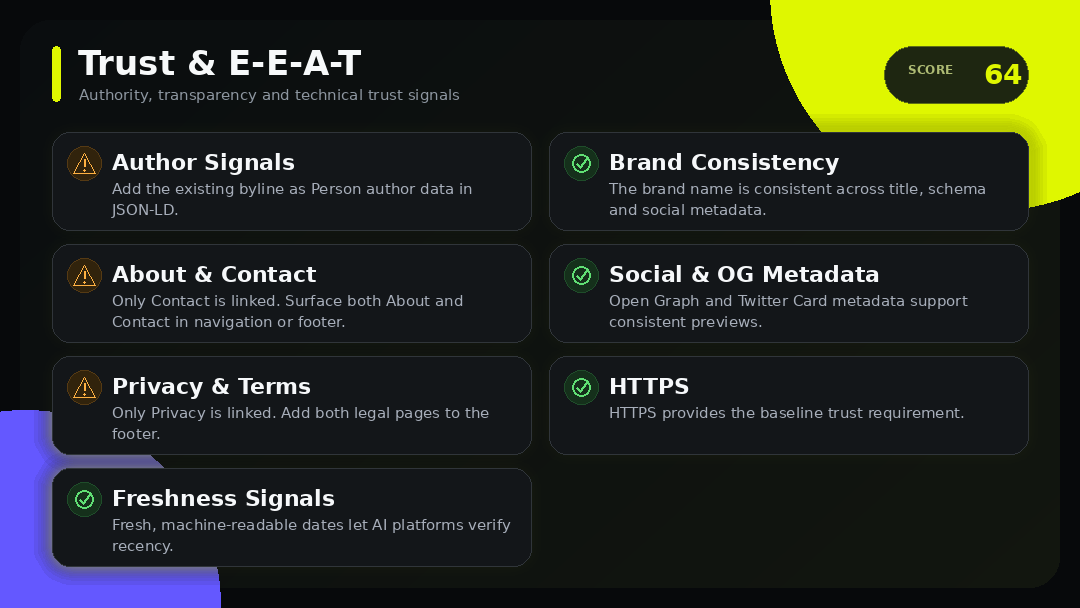
V. Trust & EEAT: Giving AI Reason to Trust You
AI places great importance on content sources. This is especially true in B2B procurement scenarios, where the authenticity, professionalism, and credibility of businesses are crucial. Therefore, websites need to continuously build upon EEAT: experience, professionalism, authority, and credibility.
Author information, company introduction, contact information, brand information, update time, client cases, certifications, production capacity, etc., can all help AI further assess a company's credibility. At the same time, the brand name on the website needs to be consistent. The company name, brand name, social media accounts, website information, etc., should ideally form a consistent identity.
Essential pages such as About Us, Contact, Privacy Policy, and Terms are also indispensable. While this content may not seem like "marketing content," it actually provides AI with continuous evidence to assess the authenticity of the business. Therefore, GEO is not simply about letting AI "see you." More importantly, it's about letting AI know who you are, what you do, and have sufficient information to determine whether you are trustworthy.
Finally, I summarized GEO into 5 things:
AI Crawler Access: Bringing AI in.
Machine Readability enables AI to understand;
Structured data makes it recognizable to AI;
Content & Citability: Providing AI with content to reference;
Trust & EEAT make AI willing to believe.
Only after completing these five steps can an independent website truly possess the foundation for AI search . This is what independent websites for foreign trade really need to consider in the era of AI search.