How long does it take for Google to index and rank products? A detailed explanation of keyword time cycles for independent foreign trade websites.
Google indexing and keyword ranking are not completed within a fixed timeframe. New websites typically take 3 to 14 days for initial indexing, while new content on established websites may be indexed within hours to a day. Long-tail keywords may appear in rankings within 1 to 4 weeks, moderately competitive keywords typically take 2 to 6 months, and highly competitive core keywords may require 6 months to over a year. This article introduces how to improve the Google indexing and ranking performance of independent e-commerce websites by utilizing Google Search Console, Sitemap, internal links, high-quality content, external links, and brand building, covering aspects such as indexing, ranking, time stages, influencing factors, and optimization methods.
Why can't I see the new content I've published on my website in Google search results?
Some pages remain unindexed even after several days, while others, though indexed by Google, rank very low. Many foreign trade companies encounter similar situations:
- Google has been slow to index the new article since it was published.
- The product page has been indexed, but its search ranking is very low.
- Keyword rankings appeared initially, then fluctuated.
- The website has content, but it doesn't generate search traffic.
- Even after creating backlinks, the rankings haven't changed significantly.
These situations do not necessarily indicate that there is a problem with the website.
Google indexing and ranking takes time. This process is influenced by factors such as website age, domain authority, content quality, website structure, backlinks, keyword competition, and frequency of updates.
Therefore, when doing Google SEO, you shouldn't just look at "whether it's been indexed today" or "whether it's on the first page this week." Instead, you should understand the patterns at different stages and take appropriate optimization actions at the right time.
1. What is the difference between Google indexing and keyword ranking?
Before discussing time, we must first distinguish two concepts:
1. Included
Indexing, also known as inclusion.
It refers to the process by which Google's crawler discovers and crawls a page, then adds the page to Google's index.
Only after a page is indexed can it have a chance to appear in Google search results.
However, please note:
Being included in the index does not equate to being ranked.
A page may be indexed by Google, but it may be ranked on page 50, or even only found when searching for the full URL or brand name.
2. Ranking
Ranking refers to the position of a page in the search results for a particular keyword.
For example, user search:
custom shoe manufacturerIf your website page appears on page 3, that's your ranking position for that keyword.
Ranking typically takes longer than indexing because Google needs to make further judgments.
- Does the page truly match the search intent?
- Is the content quality sufficient?
- Does the website possess the relevant professionalism?
- Does the page have user value?
- Does the website have external signal support?
- How well are the competitor's pages performing?
Therefore, inclusion solves the following problem:
Did Google discover and save this page?
Ranking solves the following problems:
Google determines where this page should appear in search results.
2. How long does it usually take for keywords to be indexed?
Google's indexing does not have a fixed time.
Different websites, different pages, and different keywords may result in completely different speeds.
Main factors affecting the speed of data collection
| Influencing factors | illustrate | Approximate time reference |
|---|---|---|
| Crawling frequency | Active and high-authority websites are generally more likely to be crawled more frequently. | The old station takes a few hours to 1 day; the new station takes 3 days to 2 weeks. |
| External links | High-quality backlinks can help Google discover pages faster. | High-quality backlinks may be shortened to about 1 day. |
| Website Structure | A clear directory, internal links, and sitemap help with crawling. | For complex structures, delays may exceed two weeks. |
| Content quality | Original, complete content that matches the search intent is more likely to be retained. | Low-quality or duplicate content may not be indexed for a long time. |
| Sitemap submission | Submitting pages and sitemaps can help Google discover new URLs. | It may take hours to days to process. |
| Website History | Older domains typically have accumulated more trust and crawl records than newer domains. | New sites typically require a longer observation period. |
| Server stability | Unstable page access can affect Google's crawling. | Frequent error messages may cause delays. |
New site inclusion time
For newly launched websites, the initial indexing process typically requires:
It takes about 3 to 14 days.
If the website has no external links, little content, or an unclear structure, it may take even longer.
The new site doesn't have historical data yet, so Google needs to know that first.
- What industry does this website belong to?
- Is the website real and stable?
- Is the content continuously updated?
- What is the relationship between the pages?
- Does the company possess credibility?
Therefore, it is quite normal for a new website to experience slow indexing in the early stages.
The old site's inclusion time
If it's an established website that has been operating for some time, with consistently updated content and a stable structure, new content might be found in:
Discovered and recorded within a few hours to 24 hours.
However, not all pages on older websites will be indexed quickly.
If a page contains duplicate content, is of low quality, or is not closely related to the website's theme, Google may still delay indexing it, or even not index it at all.
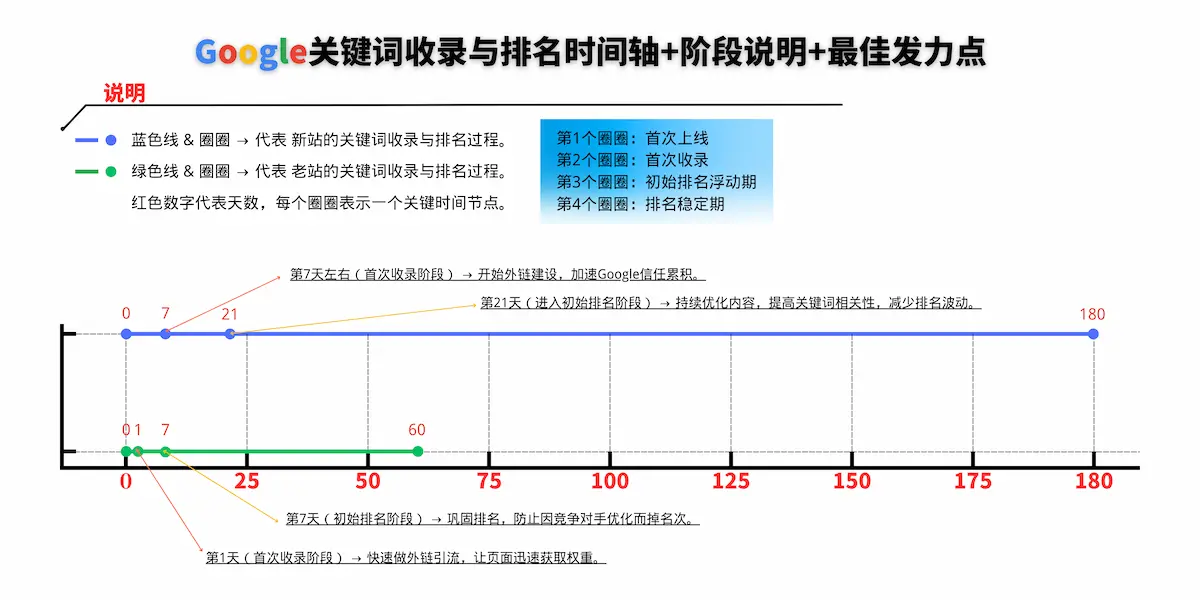
III. Timeline of Google's indexing based on screenshots
Based on the timeline you provided, keyword inclusion and ranking can be divided into several key stages.
First milestone: Launch
After the page is published, Google needs to discover this URL first.
If a page is already linked via internal links and the website has submitted a sitemap, Google will generally find it more easily.
The second time point: initial inclusion
The indexing speeds of new and old websites differ:
- New site: Usually takes 3 to 14 days
- Old site: May be indexed within a few hours to a day.
The focus at this stage is on confirmation:
- Is the page accessible normally?
- Is the page blocked by Robots.txt?
- Does the page have a Canonical issue?
- Has the page been correctly added to the Sitemap?
- Does the page contain duplicate content?
- Does the page contain enough text?
The third time point: the initial ranking fluctuation period
Based on the timeline, some new website pages may appear in the initial rankings in the first few weeks after going live.
Rankings at this stage are usually unstable; a person might be ranked 30th today, drop to 70th a few days later, and then reappear.
This doesn't necessarily mean the page has been penalized; rather, Google is still evaluating the page's relevance and quality.
The fourth time point: the ranking stabilization period
Keyword rankings can only gradually stabilize after a page has undergone continuous crawling, content optimization, internal link building, and the accumulation of external signals.
This process could take weeks to months.
IV. How long does it typically take for keyword ranking to take place?
Keyword ranking usually takes longer than page indexing.
A rough judgment can be made based on the level of competition.
| Keyword types | Approximate time for new station | Approximate time of the old station | Main influencing factors |
|---|---|---|---|
| Long tail keywords | 1 to 4 weeks | Several days to several weeks | Content relevance and level of competition |
| Medium-competition keywords | 2 to 6 months | 1 to 3 months | Page quality, backlinks, and website authority |
| Highly competitive keywords | 6 months to 1 year or more | 1 to 6 months | Industry competition, domain name authority, external information sources |
These timeframes should only be used as a reference and should not be interpreted as an official commitment from Google.
1. Long-tail keywords
Long-tail keywords are usually more specific, have relatively lower search volume, but have a clearer search intent.
For example:
custom shoe manufacturer for small brandscompared to:
shoesLong-tail keywords are generally easier to get initial rankings.
For new websites, long-tail keywords may appear in rankings or receive a small number of clicks within 1 to 4 weeks.
2. Keywords with moderate competition
Medium-competition keywords typically have a certain search volume and a large number of competing pages.
For example:
private label footwear manufacturerThese types of words usually require:
- More complete product page
- A clearer page structure
- Related content support
- Internal links
- External links
- Continuous optimization
New sites may take 2 to 6 months, while established sites may take less time.
3. Highly competitive core keywords
Highly competitive keywords typically include broad industry terms, broad product terms, and terms with high commercial value.
For example:
shoe manufacturercustom shoesCompetitors for these types of keywords may possess:
- Older domain names
- More external links
- Stronger brand awareness
- Richer content
- Higher user behavior data
- More complete product pages
Therefore, it usually takes more than 6 months, or even longer, for a new website to rank on the first page of search results for these types of keywords.
5. Why is it included in the index but ranked so low?
This is a very common situation.
A page ranking low after being indexed may be due to the following reasons:
1. Insufficient content quality
Although the page has content, the content is too simple, merely repeating some basic promotional phrases, and cannot truly answer customer questions.
For example:
We are a professional supplier with high quality and good service.
This kind of expression contains little information and cannot fully explain what the company can actually do.
Better content should explain:
- Product Type
- Product Specifications
- Materials and processes
- Minimum order quantity
- Production capacity
- Service Process
- Scope of delivery
- Frequently Asked Questions
- Customer application scenarios
2. Page does not match search intent.
The customer wants to find suppliers, but the page only shows company introductions.
The customer wants to know the product specifications, but the page only has a few pictures.
The customer wants to compare options, but the page doesn't provide any differentiating information.
Google determines whether a page is worth ranking based on the user's search intent.
3. Keyword competition is too fierce.
The page itself has no obvious problems, but the competitors are stronger overall.
At this point, continued accumulation is necessary:
- content
- external links
- Brand Search
- Industry sources
- User access
- Professional Page
4. Insufficient website authority
The new domain lacks historical data and external recognition, and Google needs time to build trust.
This is also why it's not suitable for new websites to focus solely on highly competitive keywords from the outset.
5. The page lacks internal links.
If a page is not linked to by other pages on the website, Google may have difficulty determining its importance.
You can link to the target page from the following pages:
- front page
- Product Category Page
- Related product pages
- Blog Post
- Case Study Page
- Service Page
6. The content has not been re-evaluated after the update.
Google will not immediately provide a final ranking after you modify your page.
The page needs to be re-crawled, re-understood, and re-evaluated.
Therefore, newly published or modified pages need to be observed for a certain period of time.
VI. Google Indexing and Ranking Timeline
The process after new content is released can be simply understood as four stages.
Phase 1: Page Discovery
Timeframe: 0 to 7 days after launch
During this phase, Google primarily focused on:
- Discover page
- Read URL
- Fetch page content
- Determine if the page is accessible
- Check the website's basic structure
At this point, you can focus on checking:
- Should a Sitemap be added to the page?
- Does the page have internal links?
- Does Robots.txt allow scraping?
- Does the page return a normal status code?
- Is Canonical configured on the page?
Phase Two: Initial Data Collection
Timeframe: A few days to two weeks after launch
Google has begun determining whether a page is worth adding to its index.
You can check this using Google Search Console :
- Has the page been indexed?
- Has the page been crawled?
- Are there any indexing issues?
- Is it marked as a duplicate page?
Phase Three: Initial Ranking Fluctuations
Timeframe: Approximately week 1 to week 3, or longer
The page may start appearing in some keyword search results, but the ranking is not stable.
Do not immediately delete the page or make significant changes to the content just because the ranking has temporarily dropped.
Further observation is recommended:
- What keywords did the page receive for exposure?
- Which keywords are most relevant to the page's theme?
- How users actually express their searches
- Has the page been clicked?
- Which parts need to be supplemented?
Phase Four: Ranking Stabilization and Continuous Optimization
Timeframe: 1 to 6 months, possibly longer for competing keywords.
This phase needs to be continued:
- Content optimization
- Page structure adjustment
- Internal link building
- External link building
- Product Information Supplement
- User experience optimization
- Data Analysis
Based on the timeline you provided, you can start building backlinks in the earlier stages; once you enter the initial ranking stage, you should focus on improving content relevance and reducing ranking fluctuations.
7. When should I start building backlinks?
Backlinks don't necessarily have to wait until rankings appear before they're built.
If the page has been basically optimized and the content can truly meet the relevant search needs, you can gradually start building external information sources.
New site early stage
It is not recommended for new websites to purchase a large number of low-quality backlinks at the beginning.
It is more suitable to start from the following directions:
- Company Directory
- Industry media
- Business Association Website
- Exhibition Page
- Partner websites
- Customers or supply chain partners
- Professional content platform
- Brand social media
After initial recording
Once the page starts to be crawled and indexed by Google, you can continue to accumulate external information sources relevant to the industry.
The key is not quantity, but:
- Is the website relevant?
- Is the source authentic?
- Is the content natural?
- Is the link stable in the long term?
- Can it bring real visits?
Ranking fluctuation period
When rankings fluctuate, it is recommended to continue optimizing content relevance while avoiding creating a large number of backlinks in a short period of time.
SEO is not about short-term traffic generation, but about gradually building website credibility.
8. Practical methods to speed up indexing and improve ranking
1. Submit the URL using Google Search Console
After a new page is published, you can use the "Check URL" function in GSC to confirm the page status and request a crawl.
However, please note:
Requesting a crawl does not guarantee that Google will immediately index the page, nor does it guarantee that the page will be ranked.
2. Submit XML Sitemap
Ensure your website has a proper sitemap and only submit important, accessible pages that you want to be indexed.
A sitemap should not contain:
- Deleted page
- Duplicate Pages
- Pages that are blocked from being crawled
- Worthless parameter page
- A large number of temporary URLs
3. Establish clear internal links
New pages should ideally be linked to by related pages.
For example, an article about "Google keyword ranking time" can be linked from the following page:
- SEO service page
- Foreign trade independent website construction page
- Google SEO Basics
- Website data analysis articles
- Content marketing articles
4. Optimize page content
Page content should revolve around customer questions, rather than simply repeating keywords.
Additional information can be added:
- Specific Cases
- Data and time range
- Operating method
- Frequently Asked Questions
- Product or service applicable scenarios
- Enterprise Experience
- Executable recommendations
5. Optimize the basic page structure
Check the following:
- Is the title clear?
- Is H1 accurate?
- Is the H2 structure reasonable?
- Is the Meta Description complete?
- Is Alt configured for the image?
- Is the URL concise?
- Does the page support mobile devices?
- Is the page speed reasonable?
- Does the content contain duplicates?
6. Build high-quality external links
External links should be sourced from industries and target markets as closely as possible.
Compared to acquiring a large number of low-quality links in a short period of time, a small number of stable, genuine, and relevant links are more valuable.
7. Improve domain name and brand authority
Domain authority is not something that can be built up in one go.
It comes from long-term accumulation:
- Continuously updated content
- Get industry mentions
- Building Brand Search
- Obtain genuine backlinks
- Provide professional product information
- Maintaining a stable website experience
- Establish consistent corporate signals
9. How to determine if SEO optimization is effective?
Don't just look at the ranking of a single keyword.
A more comprehensive observation is recommended:
- Is the page indexed?
- Has the number of impressions increased?
- Has the number of clicks increased?
- Has the click-through rate improved?
- Has the number of ranked keywords increased?
- Has traffic to the target country increased?
- Has the number of product page visits increased?
- Should contact form submissions be increased?
- Click to add via email or WhatsApp
- Has the quality of inquiries improved?
Some keywords may not rank highly, but they can bring in very targeted customers.
Conversely, some keywords rank well but receive no inquiries.
Therefore, the SEO of independent foreign trade websites should not only be judged by "rankings," but also by:
Did the ranking bring in target customers, and did those target customers achieve effective conversion ?
X. Conclusion of SeekClue
There is no single, universally applicable answer to Google indexing and ranking.
Generally speaking:
- It may take 3 to 14 days for a new site to be indexed for the first time.
- New content on an established website may be indexed within hours to a day.
- Long-tail keywords may appear in rankings within 1 to 4 weeks.
- Medium-competition keywords typically take 2 to 6 months.
- Highly competitive keywords may take 6 months to 1 year or more.
These are just general guidelines; the actual timeframe will be affected by factors such as website infrastructure, content quality, keyword competitiveness, backlink quality, and ongoing operational status.
Most importantly, don't assume that SEO is ineffective just because a page doesn't rank for a few days.
SEO is more like a continuous process of accumulation:
First, let Google discover the page; then, let Google understand the page; finally, through content, trust, and external signals, let the page gradually achieve a more stable ranking.
If you are encountering the following problems:
- The new page is not being indexed yet.
- Product keywords have consistently ranked low.
- The website has traffic but no inquiries.
- I don't know how to plan my SEO content.
- There is no direction in building backlinks.
- Unsure what to optimize for the website first
You can contact SeekClue . We can help you develop a more suitable long-term customer acquisition growth plan for your independent website, covering aspects such as website structure, page content, keyword strategy, SEO techniques, external sources, and conversion paths.