
Why can't foreign trade rely solely on passive inquiries, nor can it rely solely on proactive development?
Foreign trade customer acquisition cannot rely solely on platform inquiries, nor can it rely solely on proactive outreach. A combination of passive and proactive customer acquisition is necessary to establish a more stable and sustainable customer acquisition system.
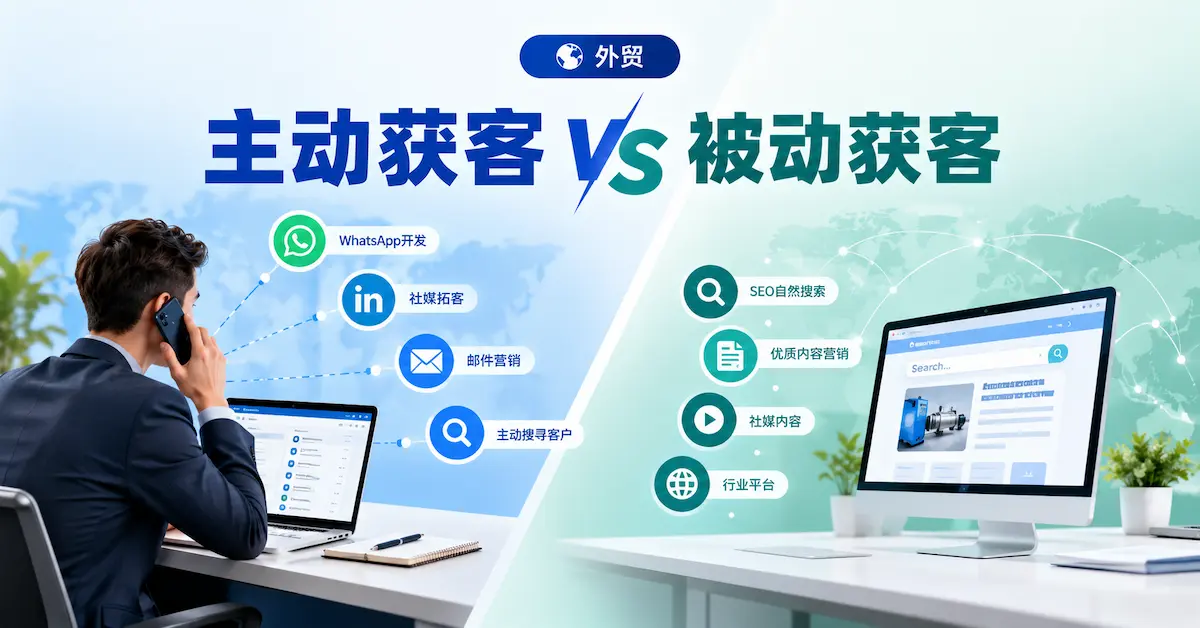
Passive inquiries and proactive development are essentially two different customer acquisition logics.
Why is the quality of sales different between customers who proactively reach out to us and those we proactively seek out? Customers from platforms are usually easier to talk to. This is because they already have a need; they might be searching for products or suppliers on the platform and just happened to come across you.
These kinds of clients don't require much negotiation time. They ask about prices, we quote; they ask about delivery times, we answer; they send product images, we verify; for clients with specific needs, we can even quickly move on to the quotation and sampling stage. Therefore, many foreign trade companies become dependent on these platforms. Clients come to them on their own – how convenient!
This also presents a problem: just because a customer actively seeks you out doesn't mean they'll only contact you. If they search for a product on a platform today and see your company, they'll usually also look at several, or even a dozen, competitors.
If you quote $100, he might check with three other suppliers; if you say delivery in 7 days, he might check with another; if you provide a solution, he might use it to compare with others. This is because most buyers operate this way. As long as they have a need, they will actively seek out more suppliers. Therefore, customers brought in by platforms have lower communication barriers, and competition is often more direct. If you can get this inquiry, your competitors also have the opportunity to get it.
Advantages and limitations of platform inquiries
The platform's biggest advantage is its ability to help businesses connect with customers who already have purchasing needs.
The fact that customers have started searching for products and looking for suppliers indicates that a purchasing process has already taken place. For salespeople, these customers are usually easier to communicate with regarding specific products, prices, MOQ, delivery time, and samples.
However, the problems are also quite obvious.
When a customer contacts multiple suppliers simultaneously, price, delivery time, product specifications, and service capabilities all become factors in the comparison. Receiving an inquiry does not necessarily mean a company has acquired a customer.
Therefore, passive inquiries address "whether the customer has found you" , but not necessarily "why the customer chose you".
The difficulty in proactively developing clients lies in getting them to want to know you.
Proactively developing clients is a completely different story. You actively seek out potential clients through Google, LinkedIn, WhatsApp , email, or other channels. The challenge here isn't closing the deal, but getting the client to respond. This is because these clients may not currently have any purchasing plans.
You send him your first email, and he might not reply. After some time, you contact him again, but there's still probably no response. Perhaps you've researched his company, done background checks , and carefully written a sales email, but he won't even read it. You need to gain the right to communicate first; that's the hardest part of proactive client development.
Platform customers are those who "have a need, so they come to you ." Proactively developed customers are those who "don't know you, and you need to find ways to make them willing to get to know you ." The difficulty levels are completely different. However, the situation changes when proactively developed customers are willing to start communicating with you. This is because these customers aren't simultaneously inquiring with multiple suppliers on the platform; rather, the relationship is gradually built through your development, screening, and communication.
Why is he willing to talk to you? Perhaps your product aligns with his needs, or perhaps you've solved his current problem, or maybe the information you provided makes him feel you're professional. In short, his willingness to spend time replying is itself a screening process. Therefore, proactively developing clients is more difficult in the initial stages, but closing the deal is often easier later.
Actively developing and accumulating more than just inquiries
There is another value in proactive development that is easily overlooked.
Platform inquiries are usually an immediate need, while proactive customer development is more like building your own customer pool.
If you contact 100 potential customers today, only a few may reply; some of them may not have a need at the moment; after some time, some of them may re-emerge with purchasing plans.
Therefore, proactive customer acquisition should not only focus on how many emails were sent or how many WhatsApp contacts were added today, but also on how many effective and potential customers were accumulated over a period of time.
Why can't foreign trade rely solely on platforms to acquire customers?
This is why I say that acquiring customers in foreign trade cannot rely on only one method. The problem with relying solely on platforms isn't a lack of customers, but rather that the source of your customers is largely controlled by the platform. If the platform gives you traffic, you'll get inquiries; if the platform's traffic decreases, inquiries will also decrease.
However, relying solely on proactive customer acquisition also has its problems. You can find many potential clients, but there's a long road between finding a client, getting a response, and generating a demand. If the team lacks the ability to continuously develop new clients, it's easy to stop after a while. However, you can also use some foreign trade customer acquisition systems to find the contact information of tens or even hundreds of thousands of potential clients in various industries.
Platforms, Google, and independent websites play different roles.
Therefore, I believe the ideal scenario is to run both models simultaneously. Platforms and independent websites are more like catching up with people who already have needs. Proactive development, on the other hand, is about proactively appearing in a customer's field of vision before they even contact you. This way, you don't place all your hopes on " when will the customer contact me? "
For foreign trade companies, there is no need to choose just one of the following: Google search, independent websites, B2B platforms, social media, and proactive development.
They solve different problems.
Someone already knows what they need and is searching for suppliers; at this point, what's needed is to make it possible for the customer to find you.
Some people may not have actively searched yet, but they are already your target customers . In this case, you need to proactively reach out to them.
If a company does both, its customer acquisition reach will naturally be larger.
The methods for closing deals and maintaining relationships differ between the two types of customers.
Furthermore, the follow-up maintenance methods for these two types of customers are quite different. For customers from the platform, more emphasis should be placed on response speed, pricing, product competitiveness, and differentiation, because customers can easily make comparisons.
For clients acquired proactively, it's even more important to focus on long-term relationships. The first time might just be an inquiry, the second a small order to test the waters. If things go well, they might come back to you again. It's through this gradual process that a more stable client relationship can be built.
Don't just look at the first transaction.
The value of foreign trade clients cannot often be judged solely by their first order.
A customer's first order may not be large, but if the product matches, delivery goes smoothly, and communication is efficient, they may continue to make purchases.
Especially in B2B business, once a customer establishes a supply relationship, changing suppliers also incurs costs.
Therefore, what truly deserves attention is not just whether this inquiry resulted in a transaction, but also the possibility of repeat purchases, continuous procurement, and long-term cooperation from the customer.
What should a truly mature customer acquisition system for foreign trade look like?
A truly mature customer acquisition system for foreign trade isn't about debating whether platforms or proactive development are better. It's about solving another problem: when customers reach out to you, do you have the ability to connect with them? And when they don't reach out, do you have the ability to proactively reach them and establish contact? Only by doing both of these things well can a company's customer acquisition structure be considered truly complete. Relying on only one method will inevitably leave you somewhat passive.
Passive customer acquisition is responsible for fulfilling demand, while proactive customer development is responsible for creating opportunities.
The two modes can be simply understood as:
Passive customer acquisition: Catching up existing demand.
Customers are searching for products, suppliers, or solutions, and you need to make your company, products, and website stand out in front of them.
Proactive development: Create more opportunities for contact.
Your client may not be actively seeking you out yet, but you can proactively reach them through Google, LinkedIn, WhatsApp, email, and other means.
One is more like "catching up after the demand appears", while the other is "establishing contact in advance before the demand appears or is clear".
Combining these two approaches will prevent businesses from becoming completely reliant on a single channel.
Don't give up on proactive development just because there are no immediate results.
Don't think that having many customers on a platform means you don't need to actively develop new ones. Who doesn't want more customers? It's wrong to think that a method is ineffective after a month of inactive customer development. Acquiring customers in foreign trade is a long-term process of accumulation.
More often than not, proactive customer development is a process of continuous accumulation. Platforms and search engines continuously connect customers, and through subsequent communication, pricing, transactions, and repeat purchases, customers are gradually retained. What foreign trade truly needs to build is not a single "sales-boosting channel," but rather a customer acquisition system that can both meet demand and proactively create opportunities.
Why do foreign trade companies need to establish their own customer acquisition systems?
For many foreign trade companies, the real problem they need to solve is not "which channel is the best", but whether they have a customer acquisition method that can operate sustainably.
Platforms can generate inquiries, independent websites can handle search traffic, Google can help customers find businesses, LinkedIn and WhatsApp can help sales proactively reach out, and emails can provide continuous follow-up.
When these channels are combined, businesses no longer have only one way to acquire customers.
Moreover, over time, a company's own website content, search rankings, customer databases, social media accounts, and historical communication records will gradually accumulate.
This is completely different from simply waiting for the platform to assign inquiries.
Passive inquiries and proactive outreach are not mutually exclusive.
If we absolutely must make a simple judgment between these two methods:
The advantage of passive inquiries is that the customer already has a need, and the communication cost is relatively low .
The advantage of proactive development is that it allows you to actively select target customers, rather than simply waiting for them to appear on their own .
Passive inquiries are more likely to generate immediate opportunities, while proactive development is more suitable for long-term accumulation.
Therefore, what foreign trade companies should really do is not to agonize over which option to choose, but to combine the two approaches based on their own products, customers, and team situation.
When customers reach out to you, you need to have a channel to receive them.
Even if a customer doesn't actively seek you out, you should still find a way to reach them.
This may be the truly stable state of customer acquisition in foreign trade.
If you are looking for more stable ways to acquire customers in foreign trade and want to continuously acquire overseas customers through proactive development, independent websites, and Google search , please feel free to contact SeekClue to discuss your business situation.