
What are the differences between React, Next.js, WordPress, and SaaS website building? A selection guide for foreign trade companies.
React, Next.js, WordPress, and Shopify are not on the same level. This guide helps foreign trade companies choose the right independent website solution, considering factors such as control, SEO, cost, speed of deployment, maintenance, and scalability.
First, put the concepts at the correct level.
When foreign trade companies discuss website building solutions, the most common problem isn't a lack of technology, but rather comparing different levels of concepts side-by-side. React and Next.js are technical tools for developing websites, WordPress is a content management system, Shopify, Wix, Shopline, etc., belong to managed SaaS website building services, while "custom development" describes a project delivery method. Only by first clarifying the technology, product, service, and business model can discussions about cost, SEO , and scalability become meaningful.
What is React?
React is a JavaScript library for building web interfaces, primarily addressing issues related to componentization, state changes, and interactive interfaces. It is not a complete website in itself, nor does it handle databases, servers, content backends, payment systems, or SEO. If a company only says "use React to build a website," it still needs to confirm who will be responsible for routing, server-side rendering, data interfaces, CMS, deployment, and maintenance.
What is Next.js?
Next.js is a full-stack web framework built on top of React, providing capabilities such as routing, server-side rendering, static page generation, APIs, image optimization, and metadata. It is suitable for developing high-performance enterprise websites, content platforms, product databases, pricing systems, and multi-market front-ends, but development teams still need to complete the architecture, page layout, backend connectivity, and subsequent iterations.
What is WordPress?
WordPress is an open-source content management system. Businesses can maintain pages, products, and blogs through the backend and extend functionality such as SEO, multi-language support, forms, and WooCommerce through themes and plugins. It is not a programming language, nor is it inherently equivalent to a template website; even within WordPress, different themes, the number of plugins, servers, and development quality can produce completely different results.
What is SaaS website building?
SaaS website hosting involves renting a pre-developed online system on a monthly or yearly basis. The platform handles the server, underlying software, security updates, and most basic functionality. Businesses build their websites using accounts, plans, themes, and applications. Shopify, Wix, and Shopline are typical examples. SaaS describes a software delivery model, not a specific front-end technology.
Are React and Next.js considered SaaS website building tools?
React and Next.js are not SaaS by themselves. They can be used to develop websites owned independently by a company, or they can be used by a development company to build a shared, subscription-based SaaS platform. The criterion for judgment is not which framework is used in the code, but how much control the company has over the program, database, server, domain name , and data migration.
If each customer has an independent code repository, independent database, and independent deployment, and can switch service providers to continue operating, it is usually considered self-developed or custom-developed. If customers can only log in to a unified platform, choose a package, and use the functions according to the rules, and the core functions will terminate when payment is stopped, then it is closer to SaaS.
Is WordPress a SaaS website building service?
Self-deployed WordPress.org is not SaaS
Obtaining the program from WordPress.org and installing it on the company's own server constitutes a standalone deployment of an open-source CMS. The company can manage files, databases, themes, and plugins, and can also change hosts, developers, or service providers. Most foreign trade companies using "WordPress + Elementor or a custom theme + WooCommerce + a dedicated server" fall into this category.
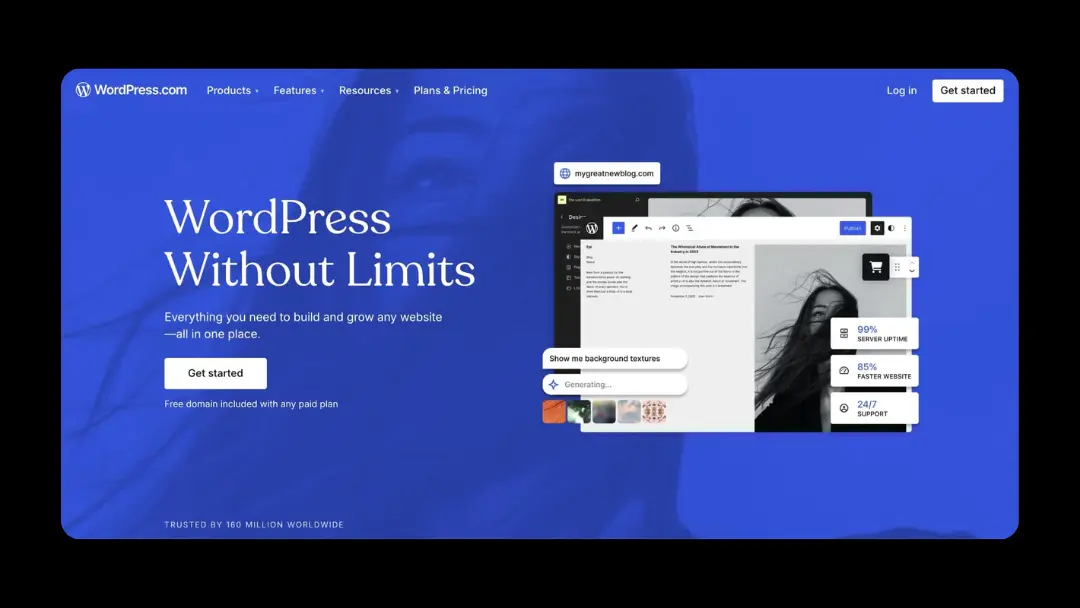
WordPress.com hosting plans are closer to SaaS.
WordPress.com offers online hosting and subscription services, eliminating the need for businesses to maintain their own servers. However, the available plugins, themes, and features are limited by the subscription plan. Therefore, when discussing WordPress, it's crucial to clarify whether it's self-deployment via WordPress.org or a hosting service via WordPress.com; the two should not be simplistically confused.
What is Shopify and other SaaS website building?
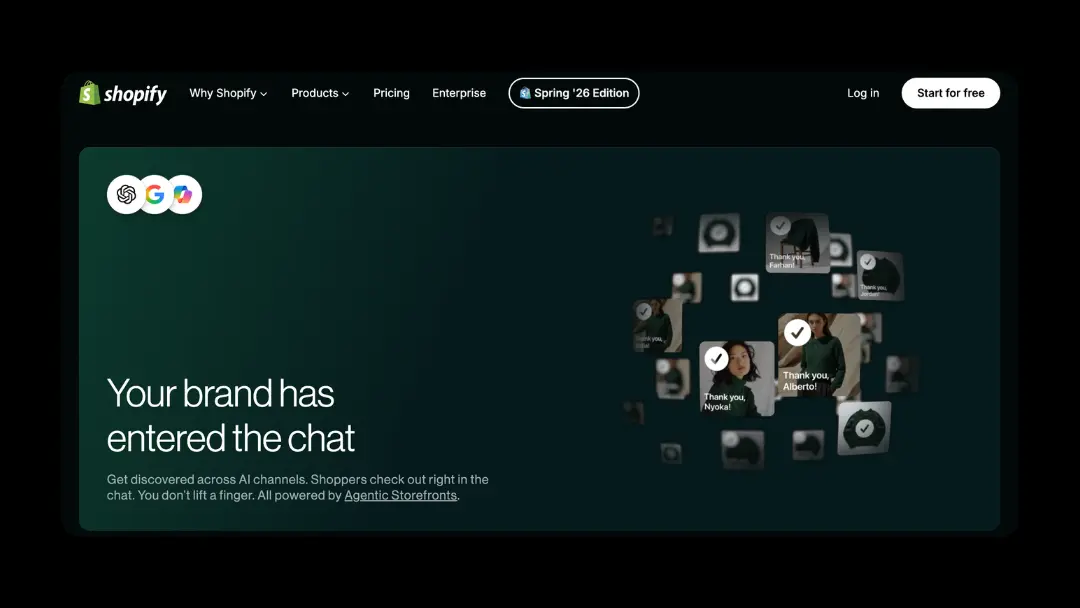
The core value of platforms like Shopify is the ability to quickly access a mature e-commerce infrastructure, including products, shopping carts, payments, orders, inventory, discounts, and an app ecosystem. Businesses don't need to develop underlying functionalities from scratch, making it suitable for standardized consumer goods, DTC brands, cross-border retail, and small teams looking to quickly validate their market presence.
The cost is that businesses need to continue to bear the costs associated with packages, themes, applications, payments, or transactions, and some business processes will be subject to platform capabilities and rules. While migration typically allows exporting data such as products, orders, and customers, page structure, theme interactions, application logic, and historical configurations may not be able to be migrated intact.
The four types of solutions cannot be compared solely based on "technological advancement".
Data and Control
Self-deployed WordPress and independently developed Next.js typically offer greater control over files, databases, and servers; SaaS platforms, on the other hand, trade convenience for some underlying control. Businesses need to confirm whether domain ownership, data export scope, media files, customer information, URLs, and redirection rules can be transferred.
SEO capabilities
WordPress boasts mature content editing and SEO plugins, making it suitable for continuously publishing category pages, product pages, and blogs. Next.js can achieve high-performance rendering, fine-grained metadata, and structured data, but only if the development team correctly implements crawling, indexing, canonical, sitemap, and content workflow. SaaS can also perform SEO, but it may be limited by the platform in terms of URLs, structured data, and in-depth technical adjustments.
Construction costs and long-term total costs
SaaS typically has lower initial costs, but will incur ongoing subscription and application fees; WordPress has moderate initial investment, with long-term costs concentrated on servers, plugin licensing, security, and maintenance; Next.js requires the highest initial investment for custom development, and subsequent feature changes rely more heavily on professional development. When choosing a solution, the total cost of ownership over three to five years should be calculated, rather than just looking at the initial year's quote.
Maintenance, safety and stability
SaaS, with its underlying maintenance handled by the platform, offers the least hassle for businesses. WordPress requires continuous updates to its core, themes, and plugins, along with proper caching, backups, permissions, and security measures. Next.js reduces the traditional plugin stacking, but still necessitates handling dependency upgrades, API security, deployment monitoring, and technical debt. No solution can truly achieve permanent maintenance-free deployment.
Functionality expansion and business adaptation
WordPress boasts strong general extensibility, making it suitable for content, presentation, inquiry processing, and small to medium-sized e-commerce businesses. However, when dealing with complex data relationships, a large number of products, and the need for real-time connections across multiple systems, plugin combinations can increase conflicts and maintenance costs. Next.js allows for the design of data structures and functions around real-world business needs, making it suitable for complex projects. SaaS is best suited for standard processes; requirements exceeding platform boundaries may necessitate application, secondary development, or business compromises.
How should you choose among the three mainstream website building methods?
SaaS website building: suitable for rapid deployment and retail e-commerce.
If a business sells standardized consumer goods and needs online payments, orders, and inventory, and wants to launch and validate overseas markets within a few weeks, SaaS solutions like Shopify are typically the most efficient. Before selecting a solution, you should list the required payment methods, target countries, application fees, transaction costs, data export, and migration plans after decommissioning.
WordPress: Suitable for most B2B foreign trade companies
If a website's core objectives are to showcase products, generate inquiries, publish content regularly, and perform Google SEO, WordPress can typically strike a balance between budget, content management, and control. For manufacturers of machinery, auto parts, industrial components, building materials, and OEMs, most of their needs can be met with a well-structured architecture and a small number of high-quality plugins.
Custom development using React + Next.js: suitable for complex and long-term projects.
If your business has a large number of products, multi-country front-ends, complex permissions, automatic pricing, 3D previews, distributor portals, deep integration with CRM or ERP, and personalized needs such as SEO automation or GEO analytics, you might consider custom development with Next.js. Its value lies not only in faster pages, but also in building a website into a digital platform connected to your business processes.
Four common misconceptions that foreign trade companies are most likely to fall into
Myth 1: Using Next.js will definitely improve SEO.
Frameworks can only provide the necessary conditions; they cannot replace keyword strategies, page content, internal links, external links, index management, and continuous operation. A misconfigured Next.js website may also experience issues such as pages failing to crawl, duplicate metadata, canonical errors, or excessive reliance on client-side rendering.
Myth 2: WordPress is always slow and always insecure
Common problems with WordPress often stem from cheap themes, excessive plugins, insufficient server configuration, and lack of updates. With proper theme development, plugin control, caching, CDN, image optimization, and security maintenance, WordPress can meet the speed and security requirements of most B2B websites.
Myth 3: SaaS cannot do SEO
SaaS platforms can handle basic and most content SEO, and also generate organic traffic. The real difference lies in the extent to which a company has control over the technical details. Platform limitations only become apparent when projects require special URL logic, large-scale templated pages, or deeply structured data.
Myth 4: Obtaining the source code equals having control.
Control includes not only the code, but also the database, media files, deployment accounts, domains, third-party services, documentation, and maintainability. Source code lacking deployment instructions, data structures, and handover documentation may be difficult to run even if obtained.
Complete the website building selection with six questions.
1. What are the main tasks of the website?
First, determine whether your goal is brand and product display, B2B inquiries, content-driven customer acquisition, or online retail transactions. The backend, page structure, and conversion path will be completely different for each goal.
II. Will long-term content publishing be necessary in the future?
If a team needs to update products, case studies, and blogs weekly, they should prioritize backend usability, editing permissions, approval processes, and image management, rather than focusing solely on frontend visuals.
3. Is it necessary to connect to a CRM, ERP, or quotation system?
The more connections a system has, the more crucial it is to confirm the interfaces, data synchronization frequency, exception handling, and permission design early on. Complex integrations are generally better suited for controlled WordPress customizations or Next.js architectures.
IV. Does the company have the technical maintenance capabilities?
If you lack technical personnel and your business is standardized, SaaS is the preferred choice; if you can outsource routine maintenance, WordPress is usually more balanced; if you have a stable development budget and a long-term product roadmap, then consider deep customization with Next.js.
V. What features will be added in the next three years?
Include multilingual support, regional sites, resellers, online pricing, memberships, payments, and data analytics in your roadmap. Don't overdevelop for distant possibilities, and don't be satisfied with the current number of pages while ignoring clear growth plans.
6. Can the migration be completed when changing service providers?
The contract should clearly define the ownership of code, databases, domains, accounts, images, design files, and documents, and plan URLs, 301 redirects, and data export in advance. Portability is a crucial indicator for determining whether a website truly belongs to the enterprise.
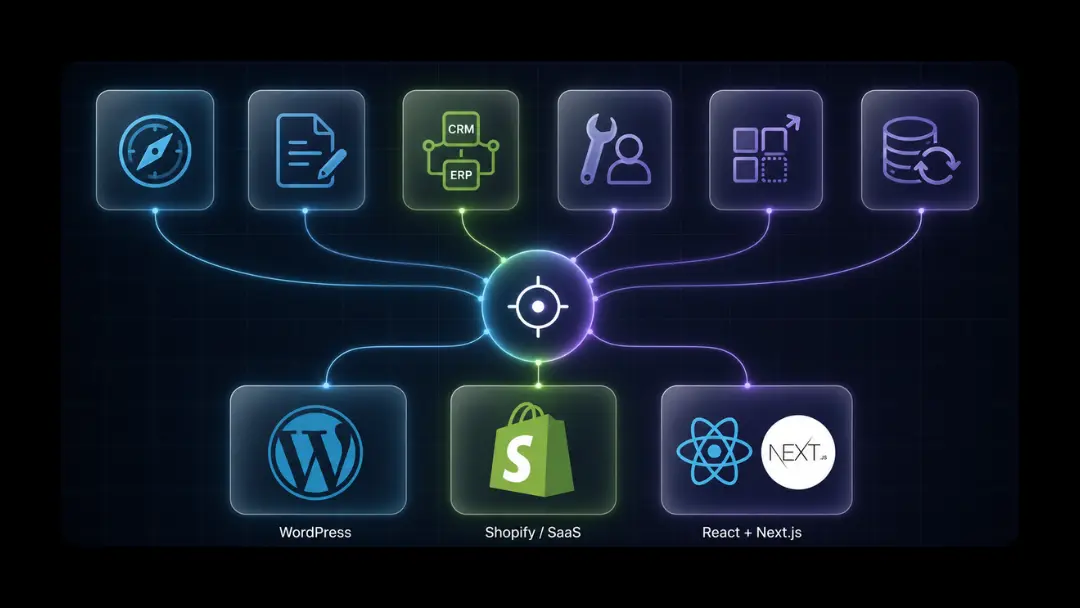
Recommended solutions for different types of foreign trade enterprises
Small and medium-sized B2B manufacturing enterprises
Prioritize self-deploying WordPress, focusing on product categorization, application scenarios, manufacturing capabilities, quality evidence, case studies, blogging, and inquiry entry points. Allocate budget to content, SEO, and ongoing operations, rather than spending all resources on initial page effects.
DTC Brands and Cross-border Retail Enterprises
Prioritize established SaaS providers like Shopify for rapid deployment of transactions and a closed-loop marketing system. Once a certain scale is reached, then evaluate whether internationalization, subscriptions, memberships, data analytics, and headless e-commerce are worth customizing.
Large product portfolio or complex business enterprises
Prioritize requirements gathering and data modeling before deciding on a Next.js + Headless CMS, standalone backend, or hybrid architecture. Complex projects should not begin with theme selection, but rather with user roles, data sources, business processes, and system boundaries.
Businesses with limited budgets but potential for future upgrades
You can first validate the marketplace using a well-structured, portable WordPress or SaaS platform, while standardizing domain names, URLs, content, and data. When upgrading to a new architecture later, you can mitigate migration losses through content export, API implementation, and 301 redirects.
Frequently Asked Questions
Is Next.js always faster than WordPress?
Not necessarily. Next.js has the potential for high performance, but actual speed depends on the code, images, APIs, caching, and deployment. A well-optimized WordPress site may be faster than a poorly developed Next.js website.
Can B2B foreign trade websites use Shopify?
Yes, it's especially suitable for companies with standardized products that require online transactions or sample orders. However, for B2B projects that are purely inquiry-based, have a large volume of content, or require complex product parameters and customized pricing, WordPress or custom development is usually more flexible.
Is WordPress truly unable to scale in the future?
WordPress's general scalability is not low. Limitations mainly arise with extremely complex data relationships, high-concurrency business logic, real-time system integration, and a large number of custom workflows. Whether a change in architecture is necessary should be determined based on the actual complexity of the business requirements.
After custom development, can I publish my own blog?
Yes, but a CMS or content backend must be integrated into the project. Next.js only provides the website framework and does not automatically provide an easy-to-use editing system. Content workflow should be explicitly listed as a requirement during the selection phase.
Should I choose the technology first or do website planning first?
First, clearly define your target customers, conversion goals, content types, product data, and future features before selecting technology. Technology is a means to achieve business goals, not the starting point or sole selling point of a website project.
Conclusion: A good solution is one that suits the business needs.
There is no absolute superiority or inferiority among SaaS, WordPress, and Next.js. SaaS solves the problems of quick adoption and standard e-commerce, WordPress solves the problems of easy-to-use content management and self-deployment, and Next.js solves the problems of complex business, deep customization, and long-term digital expansion.
For most small and medium-sized B2B foreign trade enterprises whose core business revolves around product display, inquiries, and Google SEO, WordPress remains a reliable and cost-effective choice. For cross-border retail brands that need to quickly test the market, Shopify is more efficient. For enterprises with complex data, system connections, and personalized feature paths, custom development using Next.js is more valuable. Ultimately, the decision should be made based on a combination of factors, including control, total cost, maintainability, migration capabilities, and sustained customer acquisition effectiveness.