
What is GEO? The role and implementation methods of generative engine optimization.
This article systematically introduces the definition, function, and implementation methods of GEO generative engine optimization, analyzes the differences between GEO, SEO, and AEO, and explains how independent foreign trade websites can increase their chances of being understood, cited, and recommended by AI from aspects such as AI crawling, machine readability, structured data, content citation, EEAT, and brand entities.

GEO, short for Generative Engine Optimization, refers to optimizing website content, brand information, and technical infrastructure to make generative AI tools like ChatGPT, Google AI Overviews , Gemini, and Perplexity more easily understand, verify, cite, and recommend your content.
Simply put, SEO aims for web pages to appear in search results, while GEO aims for brands or web page content to appear in AI-generated answers. For independent e-commerce websites, GEO's role is not just to increase exposure, but also to allow potential customers to understand who the company is, what products it offers, and whether it's worth contacting before even visiting the official website.
What is GEO?
GEO is a content optimization methodology for generative search and AI-driven answering scenarios.
Traditional searches typically return a set of web pages, which users then need to click, read, and compare manually. Generative AI, on the other hand, may first understand the user's question, then extract information from multiple public sources, and finally organize it into a complete answer. What the user sees may not be ten links, but an answer already summarized by the AI.
Therefore, GEO focuses not on whether a single keyword can rank, but on the following questions:
- Can AI access website content?
- Can AI accurately understand businesses and products?
- Can the information on the page answer the question independently?
- Does the content have reliable sources and factual basis?
- Does the brand maintain consistency across multiple trusted platforms?
- Does AI have any reason to cite or recommend this brand?
GEO is not about creating a website solely for AI. Technical SEO, a clear website structure, and high-quality content remain the foundation of GEO.
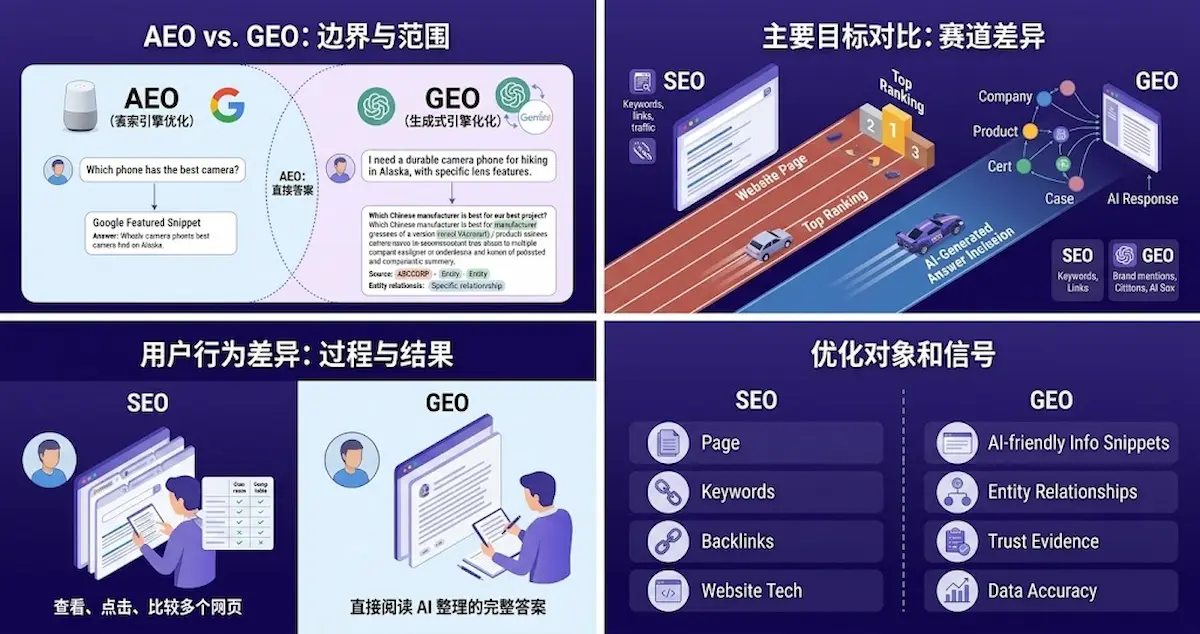
What is the difference between GEO and SEO?
SEO and GEO are not mutually exclusive. SEO helps search engines discover, understand, and rank web pages, while GEO focuses on whether this content can be extracted, summarized, and referenced by generative AI.
| Comparison Dimensions | SEO | GEO |
|---|---|---|
| Main objectives | Improve the ranking of web pages in search results | Let the content enter the AI-generated answer |
| Common platforms | Google, Bing and other search engines | ChatGPT, Gemini, Perplexity, Google AI Overviews, etc. |
| User behavior | View search results and click on the webpage. | Read the AI-generated answers directly |
| Optimization Object | Pages, keywords, links, and website technology | Cited information fragments, entity relationships, and evidence of trust |
| Content Format | Articles, product pages, landing pages | Direct answers , forms, checklists, FAQs, and specific facts |
| Common indicators | Rank, Clicks, Impressions, CTR and Organic Traffic | Brand mentions, reference pages, AI-driven traffic , and AI-generated inquiries |
| Important signal | Search relevance, page experience, and external links | Content accuracy, structural clarity, entity consistency, and source reliability |
AEO (Answer Engine Optimization) can be seen as a direction related to GEO (Gross Answering). AEO focuses more on curated summaries, voice answers, and direct answers in search results; GEO has a broader scope, including AI platforms such as ChatGPT that can generate complete answers.
What is the role of GEO?
Make your brand visible before customers visit your website.
When buyers are looking for suppliers, they may directly ask questions to the AI:
- Which Chinese manufacturers are suitable for hotel projects?
- Which OEM suppliers support small-batch customization?
- How can you determine if a factory is reliable?
- Which suppliers possess the certifications required by the target market?
The AI will search multiple sources based on the question and then compare a company's products, materials, certifications, case studies, delivery times, and service capabilities. If the publicly available information on the website is complete, the brand has a chance to be included in the AI's candidate answers.
This type of exposure doesn't necessarily lead to immediate clicks. Customers might first remember the brand name, then search for brand keywords, visit the official website directly, or use AI-generated answers as an initial screening result for suppliers.
Helping AI accurately understand enterprise entities
AI needs to verify whether the companies mentioned on different pages are the same.
If a company uses different company names, addresses, product descriptions, and contact information across its website, LinkedIn profile, industry directories, and social media accounts, AI will struggle to establish stable brand relationships. Conversely, a consistent brand name, company entity, product range, target markets, and contact information can help AI understand its brand identity.
- Who is this company?
- What it produces or provides;
- Which markets does it serve?
- Does it have customization capabilities?
- Which information can be verified by external sources?
Make the content a quoteable answer
AI doesn't readily navigate pages that only offer promotional slogans. Phrases like "We are experienced," "Leading in quality," and "Serving the world" lack specific details.
Content that is easier to understand and quote typically includes:
- Product specifications, materials, and applicable scenarios;
- MOQ, sampling, delivery time and packaging instructions;
- OEM, ODM or private label processes;
- Production equipment and quality inspection points;
- Certification number, test report, and applicable standards;
- Project case studies and real-world application conditions;
- Author, update time, and review information;
- Clear quotes, samples, or contact information.
Ultimately, GEO's role is to reduce customer uncertainty. AI can understand this, and customers should be able to understand it too.
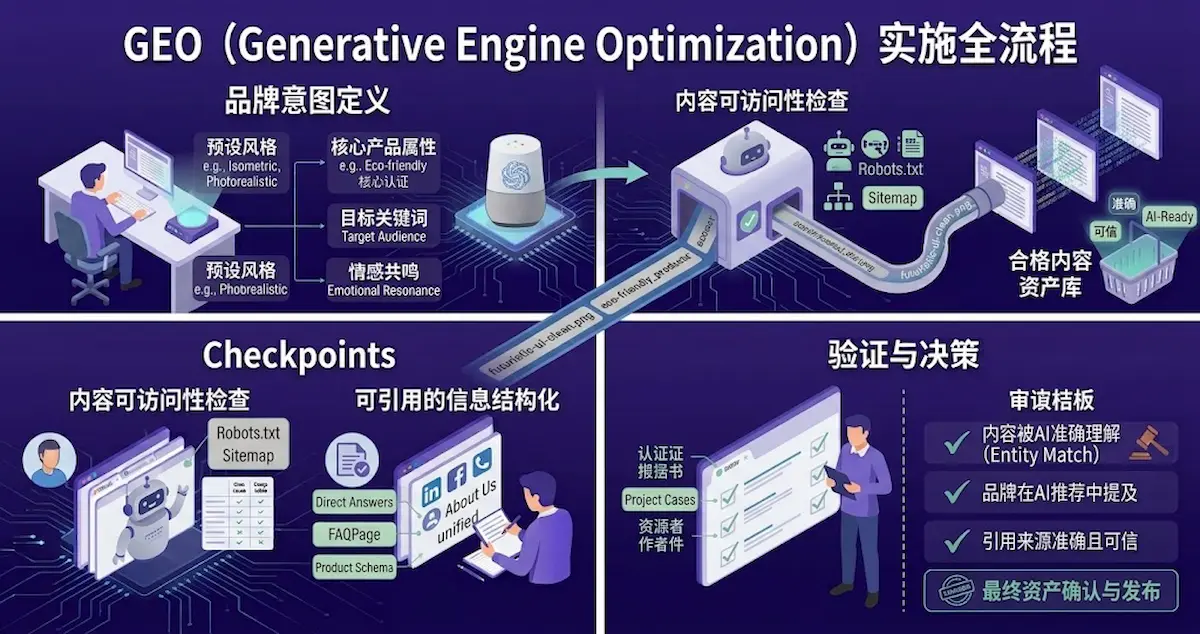
How to do GEO?
Enable AI to access websites
If website content cannot be accessed, then further optimization is meaningless.
Need to be checked:
- Does
robots.txtincorrectly prevent AI search crawlers? - Are important pages excluded by
noindex? - Does the page require login to access?
- Is the server or firewall blocking legitimate data capture?
- Does the XML Sitemap include important pages?
- Does the key content only appear after interaction or script execution?
Allowing AI crawlers to access content only means that the content has entered the scope of potential retrieval; it does not guarantee that the brand will be cited.
Make it easier for machines to understand the page
The fact that a user can open a webpage normally does not mean that the search engine and AI can efficiently parse the page.
The website should be kept as clean as possible:
- A clear and stable URL structure;
- A reasonable H1, H2, H3 hierarchy;
- Important content appears directly in the HTML;
- Correct Canonical settings;
- Consistent language and regional declarations;
- Accessible product, case, About Us, and Contact pages;
- Excellent mobile experience and fast page loading speed.
If all core product information relies on complex scripts for loading, the machine may not be able to read the complete content in a timely manner. For important pages, priority should be given to ensuring that the main text, parameters, and answers can be parsed directly.
Use structured data to illustrate entity relationships
Structured data can help the system understand what information is contained on a page.
Businesses can consider using the following methods depending on the page type:
- Organization;
- Article;
- Product;
- Person;
- FAQPage;
- BreadcrumbList.
Structured data can illustrate the relationships between companies, brands, products, authors, articles, and websites, but it cannot replace real content. Adding a schema alone will not increase a page's credibility without author information, certification documents, and product information.
Start with a direct answer
Don't take too long to answer the question at the beginning of an article or page.
If a user searches for "What is GEO?", the beginning should directly state:
GEO stands for Generative Engine Optimization, which aims to make website content easier for ChatGPT, Gemini, and other AI search systems to understand, reference, and recommend.
Then I will explain the differences, applicable scenarios, and operation methods between SEO and GEO.
Question-based titles are also more likely to match user queries. For example:
- What is GEO?
- What is the difference between GEO and SEO?
- What is the role of GEO?
- How to do GEO?
- How can I get AI to reference website content?
Each chapter should be as self-contained as possible. The reader should be able to understand what question it answers just by reading this section.
Replace vague expressions with concrete information.
Both AI and buyers need concrete facts.
Don't just write:
We offer high-quality customized services.
It can be changed to:
We support OEM and ODM projects, with customization options including materials, sizes, colors, packaging, and labeling. MOQ and lead time will be confirmed individually based on product structure, materials, order quantity, and packaging requirements.
If a certain data point cannot be publicly disclosed or fixed, you can clearly state the influencing factors and the verification process. Do not fabricate a seemingly complete figure.
Use tables, lists, and clear answer blocks.
Tables are suitable for comparing multiple products, solutions, or service terms. Lists are suitable for displaying processes, checklists, and procurement documents.
For example, supplier evaluation can be organized as follows:
| Evaluation Project | Information that needs to be confirmed |
|---|---|
| Enterprise Entity | Company name, location, website, and contact information |
| Product Capabilities | Product range, materials, specifications and applications |
| Customization capabilities | OEM, ODM, Prototyping and Packaging Range |
| Quality control | Check nodes, test files and authentication |
| Delivery conditions | MOQ, delivery time, shipping and after-sales responsibility |
| Project Experience | Customer industries, application scenarios, and publicly available case studies |
This kind of content is easier for machines to read than a series of stacked promotional slogans, and it also makes it easier for buyers to make quick judgments.
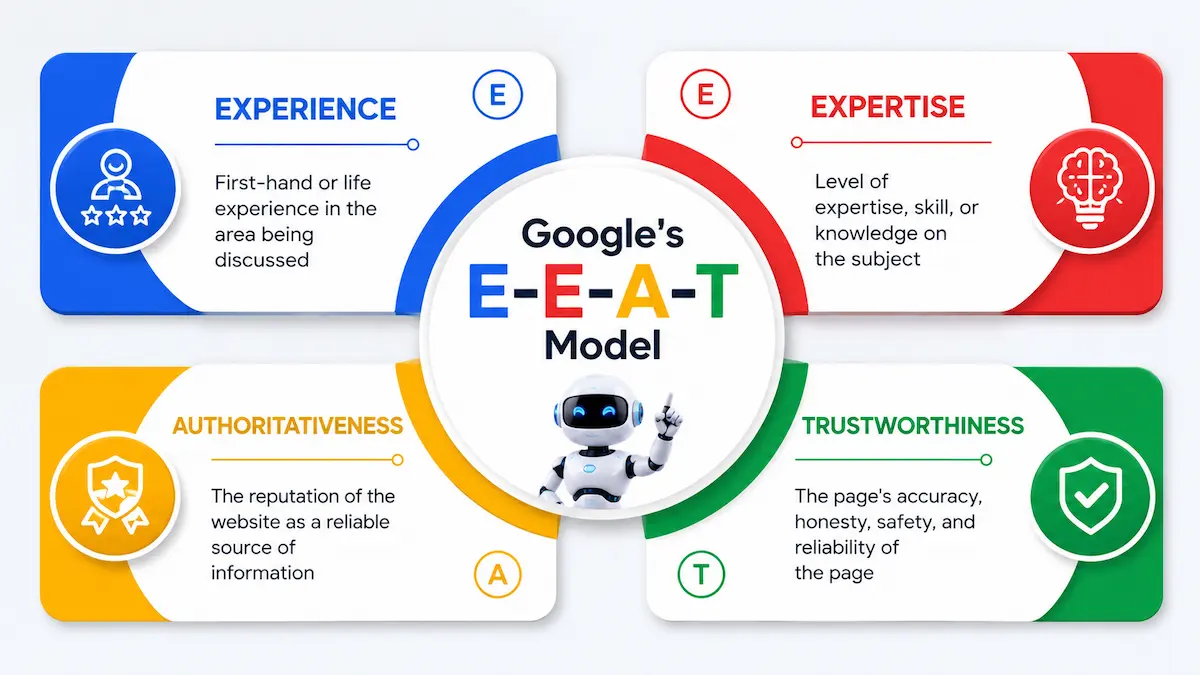
Establish EEAT signal
EEAT encompasses experience, expertise, authority, and credibility. For B2B companies, the following information is important:
- Who is the author, and does he/she have a relevant professional background?
- What exactly does the company do, and which markets does it serve?
- Are the factory, equipment, and production processes genuine?
- Are the certification and testing reports valid?
- Can the case be verified?
- Are the contact details and the company entity consistent?
- Does the page indicate the publication time and update time?
- Does the content specify the limitations and scope of application?
EEAT cannot be accomplished simply by installing a plugin. It relies on a company's long-term accumulated data, case studies, public records, and professional content.
Maintain consistency of information across multiple platforms
AI doesn't just look at one website. It might simultaneously refer to official websites, LinkedIn, YouTube, industry directories, media reports, trade show pages, and customer reviews.
Operating on multiple platforms does not equate to mechanically copying the same article. A more appropriate approach is:
- The official website publishes complete product and company information;
- Share professional insights and industry observations on LinkedIn;
- YouTube showcases product, craft, or project processes;
- The industry directory provides information on business entities and their products;
- The community platform answers real questions;
- Exhibition or association pages provide third-party records.
The content format may differ across platforms, but the brand name, product capabilities, and key facts should remain consistent.
Regularly check whether the AI accurately mentions the brand.
GEO cannot be a one-time release and then stop. Enterprises can establish a set of fixed questions for monthly or quarterly testing:
- Did AI mention brands?
- Which pages did the AI reference?
- Is the quoted content accurate?
- Have you misunderstood the type of business, products, or capabilities?
- Do competitors frequently appear while the brand does not?
- Does AI-driven referral traffic generate effective inquiries?
When testing, try to keep the questions, language, region, and platform consistent. Don't treat a single answer as a stable ranking, and don't directly take the score from the testing tool as the probability of citations.
What are the most common misconceptions about GEO?
Can GEO replace SEO?
No. Websites still need to be crawled and indexed, and pages need to have a clear structure and real value. SEO is the foundation, while GEO builds upon that foundation by adding AI retrieval and referencing scenarios.
Can adding a schema allow it to be referenced by AI?
No. A schema can help a system understand page types and entity relationships, but it cannot replace product information, author information, case studies, and credible evidence.
Does writing more FAQs always work?
Not necessarily. FAQs should answer real questions. Vague content, repetitive questions, or questions unrelated to the page's theme will actually make them harder to maintain if there are too many.
Does ranking high guarantee that your work will be cited by AI?
Not necessarily. Rankings can increase the chances of being discovered, but AI also compares content completeness, source reliability, entity consistency, and question matching.
How long does it take to see results with GEO?
There is no single, uniform timeframe. Factors such as crawling status, content quality, brand foundation, target questions, language and region, and AI platform updates all influence results. A more reliable approach is to continuously record changes in brand mentions, referencing pages, AI recommendations, and inquiries.
How does SeekClue determine if a website has GEO basics?
You can check three pages first: the homepage, the core product page, and the About Us page.
Answer the five questions page by page:
- Can AI understand who the company is?
- Are the product and service scopes clearly defined?
- Does the page answer real procurement questions?
- Can important conclusions be supported by facts?
- After the customer has finished reading, do they know who to contact next?
If these issues are still unclear, first complete the company information, product details, and procurement requirements. While a score can help identify omissions, the true value of content lies in whether the page contains clear, accurate, and verifiable information.